For years, the husband-and-wife team behind Lindye Galloway Studio built a reputation designing gorgeous interiors for clients, sourcing and specifying furniture made by others. Then, almost on a whim, founders Lindye and Winn decided to fully design and produce a single piece of their own: a nightstand.
“At the time, we had absolutely no expectations,” says Lindye. “We were still very much in the mindset of—let’s just figure this out as we go.”
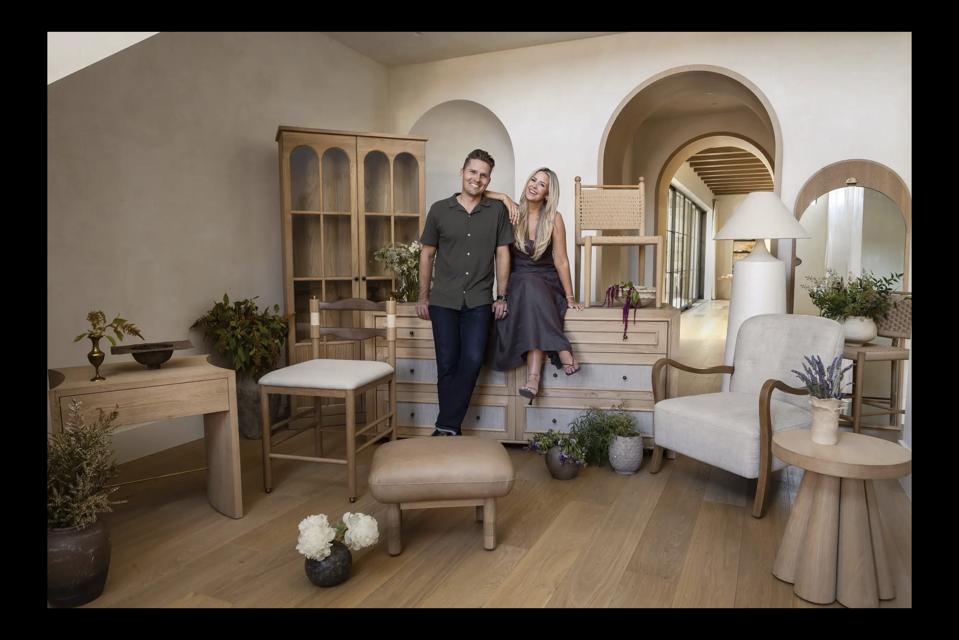
So when someone from RH (formerly Restoration Hardware) reached out with questions about the piece, the moment felt “surreal," remembers Lindye. What began as a casual Instagram message evolved into months of conversations, ultimately leading to RH officially licensing the nightstand. Today, the full Alora Collection lives prominently on showroom floors across the country.
In business, moments like this are often framed as nothing more than a “lucky break.” But that framing obscures the much more interesting question: Why do certain brands break through at all?
At least in the case of Le Maé—the furniture brand born out of the Galloways’ studio practice and propelled by the success of those first designs—the answer was visibility.
In today’s design economy, social platforms function less as supplemental marketing tools and more as necessary infrastructure: spaces where ideas are tested in public and credibility is built over time. When Le Maé began selling its own designs, it didn’t register as a pivot so much as a natural extension of a point of view that was already well established. Lindye Galloway had already built a sizable, highly engaged audience through her studio work, one that followed for taste, judgment and process. Demand existed before the products did.
Still, as much as social clout helped to amplify the work, it only mattered because the work itself held up. For Le Maé, the bestselling nightstand marked one of the first moments the team had fully designed, developed and took responsibility for a piece from start to finish.
“It made us realize we could actually do this,” Lindye says. “That we could design our own work, take on the risk, do the grunt work and see it through. That was the moment everything shifted.”
A Design Language Built In Public
Years ago, the Galloways began to understand that if their furniture brand was going to stand out, it needed to draw more directly from what they already did best: custom residential design.
“We were designing homes every day, making these very intentional choices,” Lindye explains. “And we started asking ourselves, why aren’t we bringing that same thinking into furniture?”
Much of that thinking was already being shared online. The studio’s projects—including Lindye’s decisions around materials, finishes and layout—were visible in real time on social media, long before Le Maé began selling furniture. When it came time to start producing furniture, what had resonated there, on Lindye’s social accounts, helped clarify what was really worth making.
That clarity didn’t make the process easy, though. Their earliest collection was a crash course in international manufacturing: “It’s honestly amazing the pieces even showed up,” Lindye remembers, laughing. “We knew nothing. But you learn fast.”
The team ultimately landed on Vietnam as their primary hub for case goods, drawn to its rigorous kiln-drying standards and consistency across climates. And with the logistics in place, they could focus on what mattered most: translating their interior sensibility into furniture. The result is Le Maé’s design language—restrained but expressive (think modern finishes offset by unexpected, vintage-inspired hardware).
“I love simplicity, but it has to say something,” Lindye says. “A nightstand might look straightforward at first glance, but then there’s a tassel detail on the hardware or a shift in material that changes how the piece feels.”
A Point of View, Made Physical
That material contrast has become central to Le Maé’s approach. Take the Palermo counter stool: a leather back paired with a paper-cord weave, white oak framing and brass accents. Or the Amaryllis nightstand, referenced earlier, which pairs a modern silhouette with two elegant leather pulls. “That kind of mix is still rare in produced furniture,” Lindye notes. “It’s easier to work in one material, but we’re always pushing to combine them in ways that feel intentional.”
That same thinking shapes the brand’s definition of luxury, which is ultimately rooted in real life, not preciousness.
“Luxury only works if you’re not afraid of it,” Lindye says. “If you can’t sit on the sofa or let your life happen around it, then what’s the point?"
Building What Comes Next
On the horizon for Le Maé: a potential flagship location in Newport Beach, timed to mark roughly 10 years since the studio’s founding, along with several brand collaborations slated for spring 2026. “I’m a designer who loves to evolve,” Lindye says. “I want to be ahead of where things are going, not chasing what already exists.”
Le Maé’s social-to-studio-to-shop loop isn’t a novelty or a marketing trick; it’s the foundation of how the company operates. “They’re all equally foundational,” Lindye says of the company’s many arms. “One doesn’t exist without the other." What distinguishes the brand isn’t that it emerged online, but that it treated visibility as a proving ground rather than a shortcut, using audience feedback as inputs for better design work.
“We’re still building,” Lindye says. “And that’s exactly how we want it.”