Telegram Analysis and Forensics
Forensic Challenges Introduced by Telegram’s Architecture
The same technical characteristics that define Telegram also introduce significant obstacles for investigators performing Telegram analysis and the forensic analysis of Telegram data.
Fragmented Data Locations
Telegram evidence is often distributed across both client devices and cloud infrastructure. The availability of data varies significantly by chat type: standard cloud chats may leave recoverable traces, while Secret Chats rely almost entirely on device-level artifacts, resulting in uneven evidence coverage.
End-to-End Encryption in Secret Chats
Secret Chats implement true end-to-end encryption, preventing message content from being stored on or retrieved from Telegram’s servers. Once data is deleted or a device is no longer accessible, message recovery becomes extremely limited, sharply constraining the scope of forensic analysis.
Attribution and Identity Gaps
Telegram’s emphasis on anonymity complicates user attribution. Links between accounts and real-world identities are often weak, as phone numbers, IP addresses, and device identifiers may be unavailable, incomplete, or obscured. This significantly increases the difficulty of correlating Telegram activity with specific individuals.
Cross-Device Synchronization Complexity
Telegram’s multi-device synchronization expands the potential forensic surface. Investigators must consider local caches, recoverable cloud data, and platform-specific storage differences across iOS, Android, and desktop environments. Evidence completeness may vary substantially between devices.
High-Volume, Dynamic Group and Channel Data
Groups and channels can generate large volumes of rapidly changing content. Continuous updates, member turnover, and message deletion make it difficult to capture complete datasets, preserve timelines, and verify the provenance of shared information.
Unrestricted File Types and Analysis Overhead
Telegram places relatively few restrictions on file types and sizes. Shared content may include malicious executables, encrypted archives, or obfuscated data, increasing both technical risk and analytical workload during forensic examination.
Criminal Activities Commonly Facilitated via Telegram
Due to its anonymity, encryption, and scalable communication features, Telegram is widely exploited across a broad spectrum of cyber-enabled and organized crimes. Common categories observed in investigations include:
- Online fraud and phishing schemes
- Personal data trafficking and underground data trading
- Illegal trade in drugs, weapons, and other prohibited goods
- Cryptocurrency laundering and darknet-related activity
- Hacker collaboration and malware or exploit trading
- Internal coordination within cross-border telecom fraud networks
These activities often rely on Telegram as a centralized communication and coordination platform, making Telegram analysis a recurring requirement in modern digital investigations.
Telegram Forensic Support with SalvationDATA AFA9500

AFA9500: SalvationDATA’s solution of Telegram Forensic Analysis
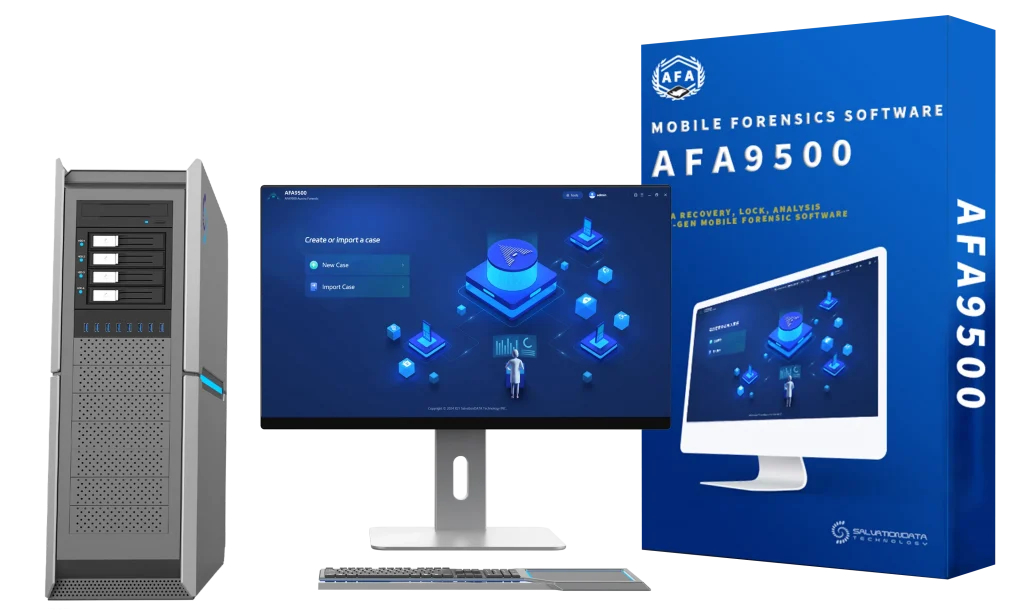
Addressing the inherent challenges of Telegram forensic analysis requires tools capable of handling fragmented data, encryption constraints, and large-scale evidence sets. The SalvationDATA AFA9500 Mobile Forensic Analysis System delivers an integrated, end-to-end solution for Telegram investigations, supporting the full workflow from data acquisition and recovery to parsing and analysis.
Comprehensive Data Acquisition
AFA9500 supports Android and iOS devices and adapts to Telegram’s mobile, desktop, and web environments. Through direct extraction, cloud-based acquisition, and offline parsing, investigators can obtain chat records, contacts, media files, login logs, IP addresses, and device information. Intelligent segmented backup ensures complete data capture even when device storage is limited.
Deep Recovery of Deleted Evidence
To address self-destructing messages and intentional deletion, AFA9500 enables recovery of deleted Telegram chats, attachments, and login artifacts from fragmented storage. Supplementary system artifacts further support account-to-device attribution.
Intelligent Analysis and Correlation
With a dedicated Telegram analysis module, AFA9500 automatically cleans, classifies, and correlates extracted data. It identifies key elements such as phone numbers, and IPs, reconstructs timelines and relationships, and helps investigators quickly identify core actors and operational structures.
Telegram’s technical design has made it a key tool for cyber-enabled crime while simultaneously creating significant challenges for digital investigations. The effectiveness of Telegram forensic analysis therefore plays a critical role in the accuracy and impact of modern law enforcement efforts. With capabilities such as multi-scenario data acquisition, deep recovery of deleted artifacts, and intelligent data analysis, the SalvationDATA AFA9500 Mobile Forensic Analysis System addresses core technical barriers in Telegram investigations and provides reliable support across cases involving sexual exploitation, telecom fraud, and cross-border crime. As cybercrime methods continue to evolve, Telegram forensics will require ongoing technical advancement, and professional forensic solutions like AFA9500 will remain essential in strengthening investigative effectiveness and promoting a safer digital environment.