Push/pull/legs (PPL) and upper/lower are popular splits to organize your weekly training. Both work well for different frequencies. For instance, push/pull/legs is simple to program for three and six weekly workouts, whereas upper/lower is built for two, four, or six workouts.
But what if you’re looking for something in the middle, such as five weekly workouts? This is where a push/pull/legs/upper/lower split can work perfectly.
Let’s discuss what it is, how it works, and what makes it a great 5-day split.
Key Takeaways
- Push pull legs upper lower is a 5-day split that consists of five distinct workouts.
- This split is ideal for anyone who wants to train five days without their schedule and workouts changing every week.
- You can start your week with push/pull/legs and conclude with upper/lower or vice versa.
- A huge benefit of PPLUL is that it allows you to train your upper body three times a week and your legs twice.
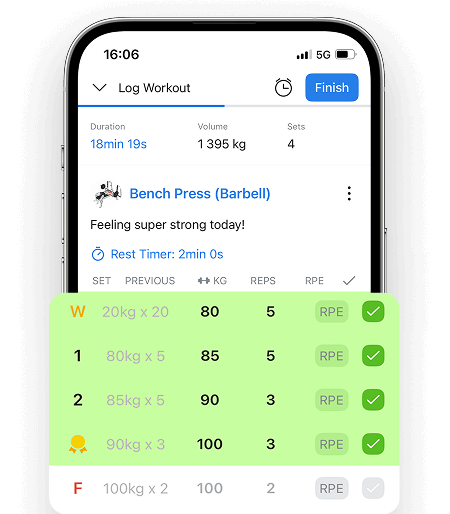
- Get the most out of this split by logging your workouts with Hevy. The app allows you to log all important details (sets, weight, reps, RPE, etc.), track your progress, and more.
What is the Push Pull Legs Upper Lower 5-Day Split?
This split combines the classic push/pull/legs and upper/lower splits. With it, you train 5 days a week, typically Monday to Friday. The PPLUL split allows you to train your upper body three times and your legs twice, ensuring that each muscle gets the attention it needs for balanced development.
The workout sequence is typically push-pull-legs-upper-lower, but you can also start with the upper and lower sessions, and then do push, pull, and legs. Here’s an example:
Monday – Upper
Tuesday – Lower
Wednesday – Push
Thursday – Pull
Friday – Legs
Saturday – Off
Sunday – Off
Here is a look at each workout:
- Push – this is where you train the upper body muscles involved in pushing motions: the chest, shoulders, and triceps.
- Pull – here, you train the upper body muscles involved in pulling: the entire back (with an emphasis on the upper back and lats), biceps, and forearms (directly or indirectly).
- Legs – you train all the muscles below the waist: the glutes, hamstrings, quadriceps, calves, adductors, and abductors.
- Upper – you train all the muscles in the upper body: the chest, shoulders, triceps, back, biceps, and forearms. You can also do some ab work.
- Lower – this is your second leg workout of the week. You can do the same session or switch it up to emphasize different muscles. For instance, ‘legs’ could focus on the quadriceps, whereas ‘lower’ could emphasize the glutes and hamstrings. We’ll share examples below.
What Are the Push/Pull/Legs/Upper/Lower Split Scheduling Options?
The PPLUL split typically involves training from Monday to Friday, with the weekend off for recovery. Example:
- Monday – Push
- Tuesday – Pull
- Wednesday – Legs
- Thursday – Upper
- Friday – Lower
- Saturday – Off
- Sunday – Off
You can also have a day off after the first three workouts, so you don’t train five days in a row:
- Monday – Push
- Tuesday – Pull
- Wednesday – Legs
- Thursday – Off
- Friday – Upper
- Saturday – Lower
- Sunday – Off
The only downside is that you would have to train on Saturdays, which could interfere with your weekend plans.
Another option for this split is to do upper/lower first, and push/pull/legs second, also known as ULPPL (upper lower push pull legs). And, similar to the previous split, you can add a rest day after the second or third workout of the week:
- Monday – Upper
- Tuesday – Lower
- Wednesday – Off
- Thursday – Push
- Friday – Pull
- Saturday – Legs
- Sunday – Off
Push Pull Legs Upper Lower 5-Day Split for Muscle Growth
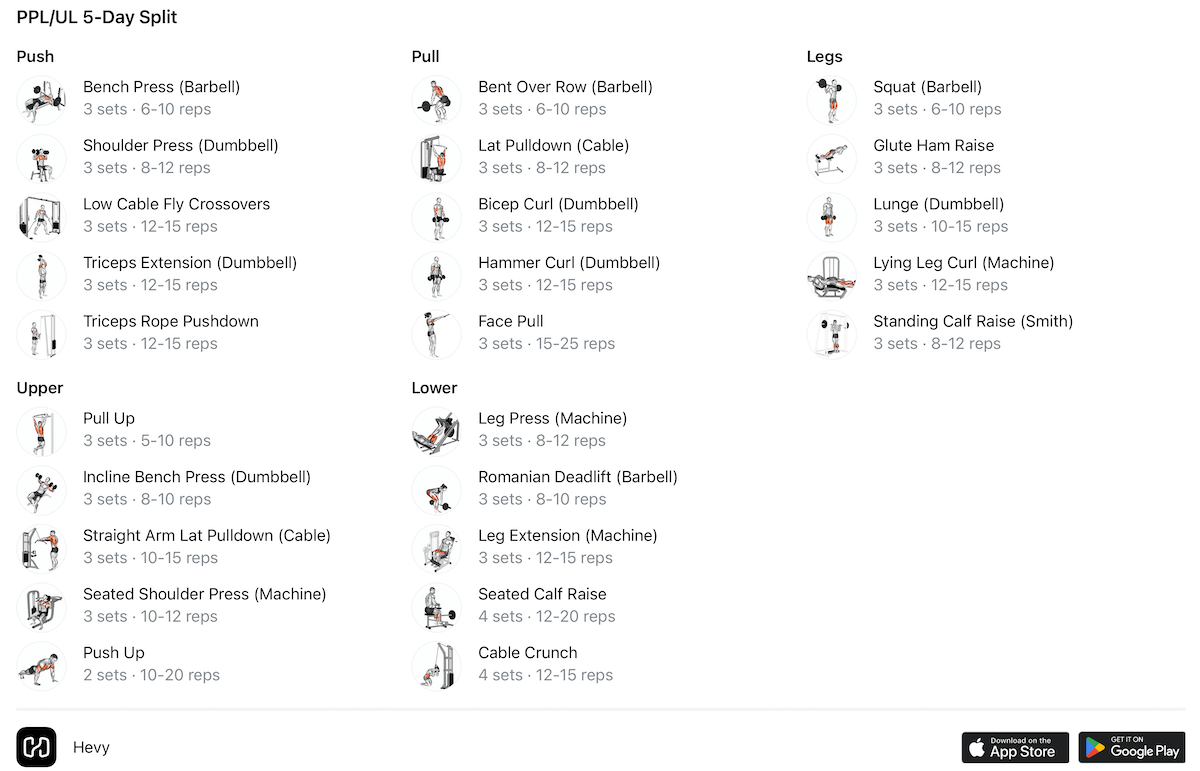
Let’s now go over a sample PPLUL split and how each workout might look. Keep in mind that this is a complete gym program you can use, but feel free to make some exercise swaps or adjust the number of sets based on your unique abilities, preferences, and constraints.
Day 1: Push
- Bench Press (Barbell) – 3 sets, 6-10 reps
- Shoulder Press (Dumbbell) – 3 sets, 10-12 reps
- Low Cable Fly Crossovers – 3 sets, 12-15 reps
- Triceps Extension (Dumbbell) – 3 sets, 12-15 reps
- Triceps Rope Pushdown – 3 sets, 12-15 reps
Day 2: Pull
- Bent Over Row (Barbell) – 3 sets, 6-10 reps
- Lat Pulldown (Cable) – 3 sets, 8-12 reps
- Bicep Curl (Dumbbell) – 3 sets, 12-15 reps
- Hammer Curl (Dumbbell) – 3 sets, 12-15 reps
- Face Pull – 3 sets, 15-25 reps
Day 3: Legs
- Squat (Barbell) – 3 sets, 6-10 reps
- Glute Ham Raise – 3 sets, 8-12 reps
- Lunge (Dumbbell) – 3 sets, 10-15 reps per side
- Lying Leg Curl (Machine) – 3 sets, 12-15 reps
- Standing Calf Raise (Smith) – 3 sets, 8-12 reps
Day 4: Upper
- Pull Up – 3 sets, 5-10 reps (or more, if you can)
- Incline Bench Press (Dumbbell) – 3 sets, 8-10 reps
- Straight Arm Lat Pulldown (Cable) – 3 sets, 10-15 reps
- Seated Shoulder Press (Machine) – 3 sets, 10-12 reps
- Push Up – 2 sets, 12-20 reps (or more if you can; train close to failure)
Day 5: Lower
- Leg Press (Machine) – 3 sets, 8-12 reps
- Romanian Deadlift (Barbell) – 3 sets, 8-10 reps
- Leg Extension (Machine) – 3 sets, 12-15 reps
- Seated Calf Raise – 4 sets, 12-20 reps
- Cable Crunch – 4 sets, 12-15 reps
Upper Lower Push Pull Legs Split Modification
There is nothing wrong with doing upper/lower first if that sequence feels more appealing. But you may want to adjust the exercises for each workout to do the harder, more taxing movements earlier in the week.
Here are the above upper/lower workouts and how you might want to adjust them if you were to start your training week with them:
| When doing PPL first | When starting the week with UL |
| Upper Pull Up – 3 sets, 5-10 reps (or more, if you can) Incline Bench Press (Dumbbell) – 3 sets, 8-10 reps Straight Arm Lat Pulldown (Cable) – 3 sets, 10-15 reps Seated Shoulder Press (Machine) – 3 sets, 10-12 reps Push Up – 2 sets, 12-20 reps (or more if you can; train close to failure) | Upper Pull Up – 3 sets, 5-10 reps (or more, if you can) Bench Press (Barbell) – 3 sets, 6-10 reps Bent Over Row (Barbell) – 3 sets, 6-10 reps Triceps Extension (Dumbbell) – 3 sets, 12-15 reps Bicep Curl (Dumbbell) – 3 sets, 12-15 reps Face Pull – 3 sets, 15-25 reps |
| Lower Leg Press (Machine) – 3 sets, 8-12 reps Romanian Deadlift (Barbell) – 3 sets, 8-10 reps Leg Extension (Machine) – 3 sets, 12-15 reps Seated Calf Raise – 4 sets, 12-20 reps Cable Crunch – 4 sets, 12-15 reps | Lower Squat (Barbell) – 3 sets, 6-10 reps Romanian Deadlift (Barbell) – 3 sets, 8-10 reps Lunge (Dumbbell) – 3 sets, 10-15 reps per side Lying Leg Curl (Machine) – 3 sets, 12-15 reps Standing Calf Raise (Smith) – 3 sets, 8-12 reps |
How to Structure Workouts Yourself
You can go about it in a somewhat templated way and pick your preferred movements for each slot. Also, feel free to rearrange the movements to some degree, but always do the compound lifts first:
Push Workouts
- Chest: one compound, one isolation
- Shoulders: one compound, one isolation (optional)
- Triceps: one or two isolation
Pull Workouts
- Upper back (horizontal pull): one compound
- Upper back (vertical pull): one compound
- Traps: optional one isolation
- Biceps: one or two isolation
- Rear deltoids: optional one isolation
Legs/Lower Workouts
- Quadriceps: two compound
- Hamstrings: one compound, one isolation
- Calves: one isolation
When doing two weekly leg workouts, one can be quad-focused, and the other can emphasize the glutes and hamstrings. In such a case, focusing on the quads could look like this:
- Quadriceps: two compound, one isolation
- Hamstrings: one isolation
- Calves: one isolation
And the second workout could be:
- Glutes: one compound
- Hamstrings: one compound, one isolation
- Quadriceps: one isolation
- Calves: one isolation
Upper Body Workouts
- Chest: one compound
- Shoulders: one compound, one isolation
- Triceps: one isolation
- Upper back (horizontal or vertical pull): one compound
- Biceps: one isolation
Optional: some isolation work for the traps, forearms, and abs/obliques
What Are the Benefits of a Push Pull Legs Upper Lower Split?
1. Good Pairing of Muscle Groups
Push/pull/legs and upper/lower are logical and effective splits, so a hybrid between the two is likely to work just as well. You have distinct workouts for your pull and push exercises; upper workouts allow you to add additional sets for these muscle groups; and the two lower body workouts offer plenty of programming options.
For example, the push workout can focus on the chest, and the upper workout can include more shoulder work. Similarly, the pull workout can mostly include upper back exercises, and the upper workout can give you the opportunity to do extra volume for smaller muscles like the rear delts and forearms.
Similarly, two leg workouts allow you to do plenty of working sets for the quadriceps, glutes, and hamstrings, as well as train the calves twice.
2. Good For a 5-Day Training Frequency
The tricky thing about a 5-day frequency is that there aren’t many suitable programming options. One advantage of PPLUL is that you get 5 distinct workouts, and you don’t have to follow a three- or four-week cycle to make it work. In contrast, other splits are harder to set up and plan for this frequency:
First, you have upper/lower, which can work, but it means that your training schedule changes from week to week. For example, here is a four-week cycle:
| Week 1 | Week 2 | Week 3 | Week 4 |
| Monday – Upper 1 Tuesday – Lower 1 Wednesday – Off Thursday – Upper 2 Friday – Lower 2 Saturday – Off Sunday – Upper 1 | Monday – Lower 1 Tuesday – Off Wednesday – Upper 2 Thursday – Lower 2 Friday – Off Saturday – Upper 1 Sunday – Lower 1 | Monday – Off Tuesday – Upper 2 Wednesday – Lower 2 Thursday – Upper 1 Friday – Off Saturday – Lower 1 Sunday – Upper 2 | Monday – Lower 2 Tuesday – Off Wednesday – Upper 1 Thursday – Lower 1 Friday – Off Saturday – Upper 2 Sunday – Lower 2 |
(Plus, in this example, you must train four days in a row––the last two workouts in the four-week cycle and the first two workouts on Week 1.)
Push/pull/legs isn’t better either, as it works best on a 3x or 6x/week frequency. Here’s how it might look:
| Week 1 | Week 2 | Week 3 |
| Monday – Push Tuesday – Pull Wednesday – Off Thursday – Legs Friday – Off Saturday – Push Sunday – Pull | Monday – Off Tuesday – Legs Wednesday – Push Thursday – Pull Friday – Off Saturday – Legs Sunday – Push | Monday – Pull Tuesday – Off Wednesday – Legs Thursday – Push Friday – Pull Saturday – Off Sunday – Legs |
The bro/body part split can work on a 5-day frequency, but it may not be the best option if you want to train your muscles the recommended two to three times per week.
3. Train Each Muscle the Recommended 2x/Week
It’s widely accepted that training each muscle twice a week is more effective for growth.
“When comparing studies that investigated training muscle groups between 1 to 3 days per week on a volume-equated basis, the current body of evidence indicates that frequencies of training twice a week promote superior hypertrophic outcomes to once a week. It can therefore be inferred that the major muscle groups should be trained at least twice a week to maximize muscle growth.“ (Schoenfeld and colleagues’ meta-analysis, 2016)
First, this leads to more frequent protein synthesis spikes, which only last for about 36 hours, according to research.
So, instead of training a muscle and waiting for seven days before training it again, you can provide a new stimulus in two, three, or four days, which could lead to slightly more hypertrophy in the long run.
Second, training muscles more often means you can spread your training volume more evenly throughout the week. For example, if you need to do 20 weekly sets for your chest, you can do 10 on push day and 10 on upper-body day.
This would allow you to do each set in a more recovered state, leading to better performance across the board, and possibly even less muscle soreness following each workout.
Related: How Many Sets Per Muscle Group For Optimal Growth?
Frequently Asked Questions
1. Is PPLUL suitable for beginners?
No, PPLUL is not good for beginners because you need to train five times per week, more than what any newbie needs. A beginner would be better off following a two or three-day full-body program. You can learn more about full body vs split routines here.
2. Does it matter if I do PPL/UL or UL/PPL?
Both options can work quite well, so long as you structure your workouts well, recover between sessions, and push yourself hard. So, choose whichever sequence you prefer.
3. How long should I rest between sets?
Here are some general recommendations:
- Heavy sets (3-6 reps): up to five minutes rest
- Moderate sets (6-12 reps): two to three minutes rest
- Lighter sets (12-20 reps): 1.5 to two minutes rest
You can rest for 1-1:15 minutes between sets if you do between 20 and 30 reps.
Related article: Rest Between Sets For Muscle, Strength, Endurance & Power
4. Where would arm and ab training fit into a PPLUL split?
You will train your biceps in pull and upper-body workouts and your triceps in push and upper-body days. Feel free to add direct ab work at the end of any workout, so long as you have the time and energy.
Conclusion
Push pull legs upper lower is a good 5-day option for intermediates and advanced lifters. It works perfectly for this frequency and allows you to do enough working sets to develop all the major muscle groups.
As always, don’t forget basics like:
- Maintaining proper form
- Training close to failure but not to failure on most sets (recording your RPE can help)
- Recovering enough between sets to maintain your performance
- Staying consistent (it’s better to train three or four days consistently than five days sporadically)
- Sleeping at least seven hours per night
- Eating enough calories for steady weight gain and protein to build and repair muscle
Lastly, check out the Hevy app before you go. With it, you can log your workouts, track your rest between sets, monitor your performance on each lift, and much more. Click here to learn more about all the features.