One of the choices you’ll continually need to make in strength training, whether you’re just starting or years into your journey, is to choose between full-body training and a split routine.
So, let’s compare the two options, learn about their benefits and drawbacks, and discuss how to decide for yourself.
Key Takeaways
- Workout splits divide your training, with each session typically focusing on specific muscle groups (say, chest and triceps), a portion of the body (say, upper/lower), or a movement pattern (say, push or pull).
- Full body training revolves around doing at least some direct or indirect work for every major muscle group during each session.
- Splits are well-suited for a higher training frequency (4+ times per week) and allow more experienced trainees to do enough direct sets for muscle growth.
- Full body sessions are more efficient and offer more scheduling flexibility. They are ideal for less experienced lifters and those who prefer a lower training frequency.
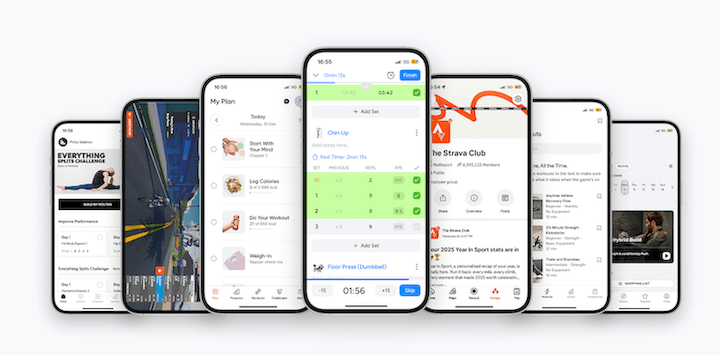
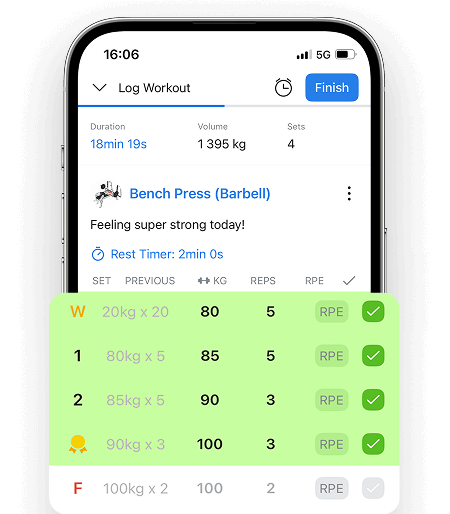
- Hevy is the perfect workout tracker for storing your training plans, logging workouts with all the necessary details, and monitoring your gym and body composition progress.
Training Splits Explained (+Pros and Cons)
Workout splits are ways to organize your weekly training by dedicating each session to specific movement patterns or muscle groups. This allows you to train all major muscles, create a good stimulus, and recover effectively between workouts.
Common options include:
- Body part split – also known as bro or bodybuilding splits, these have you focus on one or two muscles per workout (for example, having arms day, chest days, and so on)
- Push/pull/legs – here, upper body workouts focus on movement patterns (push and pull), training the involved muscles; leg workouts are standard
- Upper/lower – these split your training into upper-body and lower-body sessions
Here’s an example upper/lower 4-day split:
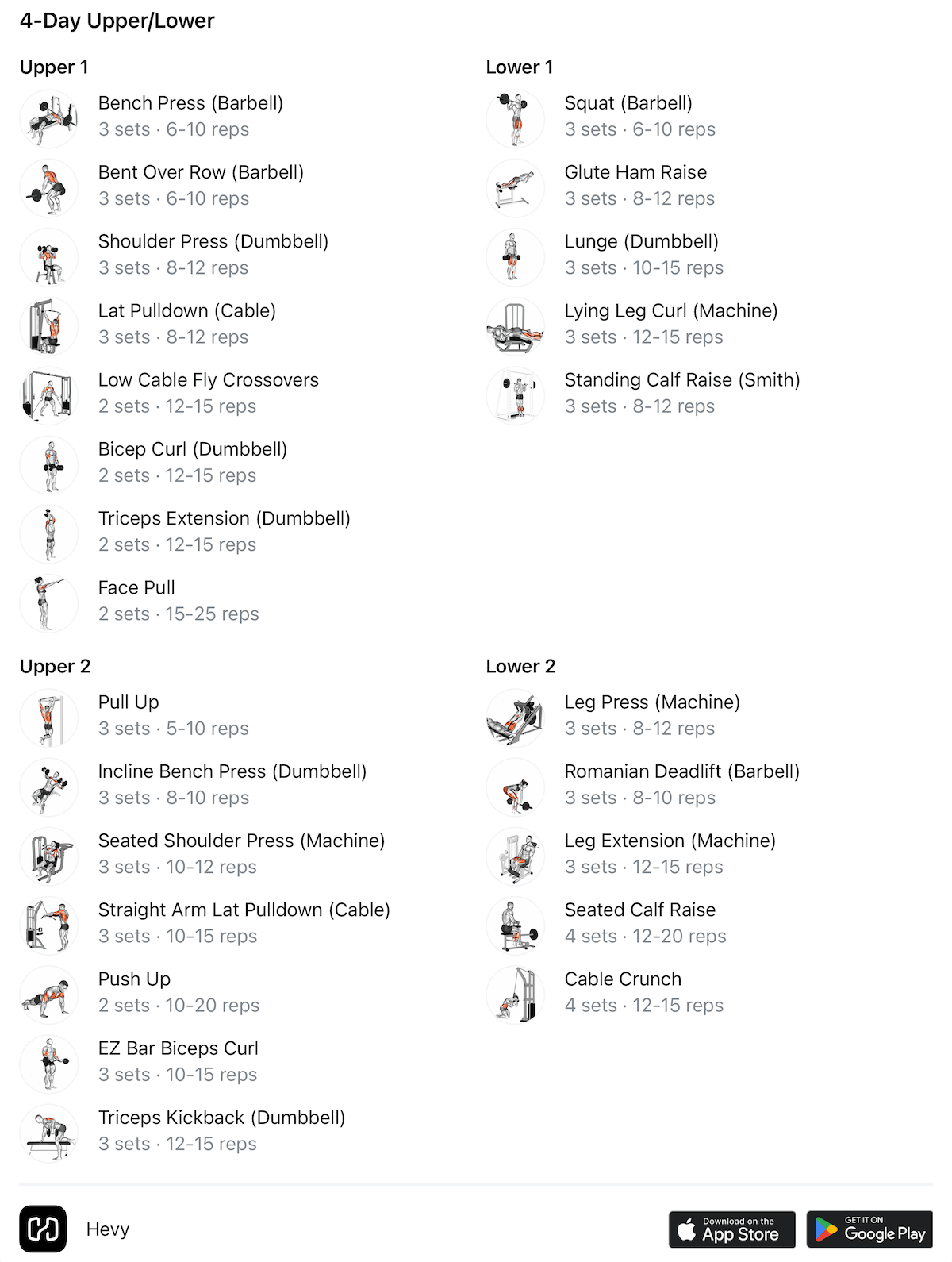
You can save this program to your Hevy app profile and start logging the workouts today:
- Open hevy.com and log in with your Hevy app credentials. (Skip if you’re on your phone with Hevy installed.)
- Click this link and tap the blue Save Folder button.
Pros of split workouts:
- You can really focus on the target muscles and potentially train them more effectively; it can be particularly effective if you struggle with the mind-muscle connection and need multiple sets to feel the target area engaging
- The target muscles get enough time to recover (usually 48+ hours); you train each muscle in a more recovered state, can perform better on each set, and progressively overload effectively
- Workouts feel more varied because each one has a focus; this reduces monotony and can keep you more engaged
- You can change your split occasionally to keep things interesting and plan your training around different frequencies; for example, you can do push/pull/legs if you train three days a week for fat loss, then switch to upper/lower for four weekly workouts while bulking
Cons of split workout routines:
- Splits can make it harder to train muscles more often unless you carefully plan your weekly training; this can lead to muscles getting more days of rest than they need
- You might need to do a lot of sets for the target muscle in one workout, which would lead to progressively worse performance in the later sets
- Training muscles harder but less often can open you up to more soreness; even if you work out consistently, you might find yourself feeling more sore than needed
- You don’t have as much flexibility to miss workouts because that would mean certain muscles get less of a training stimulus
Full Body Resistance Training Explained (+Pros and Cons)
A full body routine, also known as a full body split, is an approach in which you train most (if not all) major muscles directly or indirectly in each session. This approach is more efficient and makes it easier to target major muscles or do specific lifts more often throughout the week.
You need to be careful with how you structure your workouts to ensure that each muscle gets enough attention and that some body parts don’t get overtrained or overlooked.
Here’s an example of a full body workout plan:
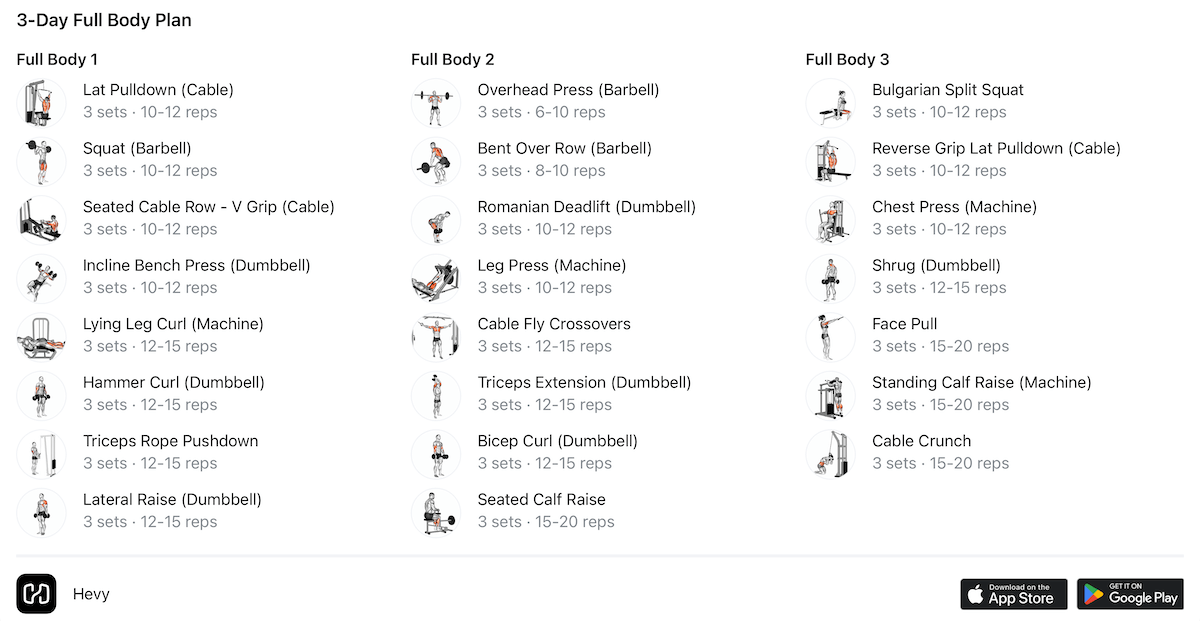
Click this link and save the program to your Hevy app profile. Read this article for more ideas.
Pros of a full body workout routine:
- Whole body workouts are more efficient and make it easier to do at least some training for each muscle; even with a lower frequency, you can make steady progress, so long as you recover well and push hard on each set
- The full body approach works well on a lower frequency – for example, training two or three times per week; this makes it a great option if you can’t or don’t want to train four, five, or six days
- Muscle soreness is less pronounced or non-existent because you rarely train any body part intensely (say, doing 10+ sets for one muscle in a single workout)
- Full body is more flexible and can work even if you occasionally need to skip or reschedule workouts; for example, even if you miss one of three workouts in a week, you’re still going to train all the major muscles to some degree
- It’s the ideal approach for strength development because it allows you to do the big lifts like the bench press and squat more often throughout the week
Cons of full body training:
- It’s less focused and doesn’t allow you to thoroughly exhaust a body part like you might be able to with a body part split; for the most part, you do 3-4 working sets for each muscle, and some muscles may only get secondary attention (like the biceps during rows)
- The workouts can end up longer and may feel more demanding if you want to do multiple compound exercises for several large muscles
- While you don’t train any body part too intensely, fatigue can still add up and affect your performance for the exercises later in the workout; for instance, if you do squats early in the workout, they can tire you out for bench presses, rows, and other compound lifts
- It can be trickier to program because sessions don’t have a specific focus, like in a body part or push/pull/legs split
Full Body Workouts vs Splits
Full body and split training are effective and can work. Research shows that both options lead to similar muscle and strength gains when training volume is the same. So, you should pick one that aligns with your preferred training frequency, goals, experience, and preferences.
Both are simply frameworks for organizing your weekly training, each with its unique pros and cons.
- Full body – the training volume for each body part is spread over more sessions
- Split routine – the training volume for each muscle is more concentrated, typically over one or two sessions
How to Choose Between Full Body and Splits
Here is a simple way to decide between full body and split training:
| If: | Then you’ll probably be better with: |
| You want to train 2-3 times a week | Full body |
| You prefer to train 4-6 times a week | Splits |
| Your schedule is inconsistent | Full body |
| You can stick to a fixed weekly schedule | Splits |
| You train for general fitness, strength, and muscle gain | Full body |
| You mostly care about muscle gain and bringing up weak points | Splits |
| You want to lose fat | Either |
| You tend to miss workouts sometimes | Full body |
| You enjoy having a clear objective for each workout | Splits |
That said, you don’t have to marry one specific approach. Your goals, preferences, and abilities will change over time, so it makes sense to adjust your weekly training structure, as well.
For example, if you’re new to working out and want to start with something sustainable, you can do full body two or three times per week. Then, as you get more advanced and want to increase the frequency, you can move to a push/pull/legs, upper/lower, or push/pull/legs/upper/lower (PPLUL) split.
Similarly, if you want to train for strength, full body will give you a solid framework to do the same compound lifts more often and include some assistance work to support that goal. But over time, you might want to switch things up and go for a different goal or training style––for example, bodybuilding-style training for muscle gain. In this case, it would make more sense to move to a split.
Another example would be alternating between bulking and cutting. Even if you’re more advanced and follow a high-frequency split while bulking, you can switch to a 3-day full body plan when losing fat. It would be a nice change of pace and make it easier to control volume when in a calorie deficit.
This also applies when life circumstances and priorities change. For instance, someone in their early twenties with fewer responsibilities and more time and energy to dedicate to working out might follow a high-frequency split. In contrast, a 40-year-old with many responsibilities and limited time and energy would find a low-frequency full-body plan more sustainable.
Lastly, we can’t forget about enjoyability. Working out should be fun and you shouldn’t force yourself to stick to something you don’t like. The more you enjoy your workouts and look forward to them, the more effort you will put into them, and the more progress you will make.
FAQ
1. Can you do full body and split training at the same time?
You can program a mixed plan, where you follow a split and include the occasional full body session. For example, upper/lower/full body (3 days per week), push/pull/legs/full body (4 days per week), or even a push/pull/full body (3 days per week).
2. How often should you switch training approaches?
There isn’t a specific rule, and you don’t need to change anything if you enjoy your workout plan and can stick to it. That said, it’s okay to change your structure if you want to try something new or if life circumstances change.
3. Does full body work if I mainly want to build muscle?
Yes, full-body training is still effective, even if you primarily care about muscle gain. You can train major muscle groups more often and distribute your weekly volume effectively. That said, you need to be careful with how you structure workouts and consider how to intelligently program assistance and isolation exercises for extra volume and emphasis on smaller muscles.
Conclusion
Full-body and split routines are two of the most common ways to organize your strength training. Both options work well, and the choice largely depends on your experience, goals, and preferences.
Before you go, check out Hevy – a simple and intuitive workout logger with all the features you need to log sessions and track progress. Store your splits or full body plans, log sets, reps, weight, and RPE, and monitor your performance on intuitive graphs.