What makes rosacea worse?
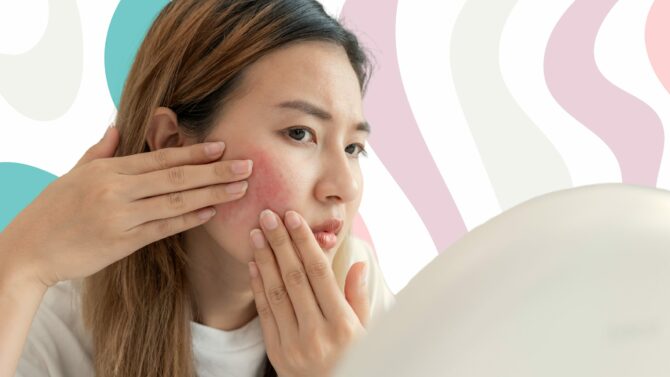
If this is starting to sound familiar, you will already know that it doesn’t take much to make rosacea kick off. Common triggers include many of the normal things that many people enjoy, such as coffee, alcohol, spicy food, hot baths, and particularly sunshine. Surveys show that 85 per cent of people who struggle with rosacea find that UV light triggers the condition; yet another reason for wearing a product with SPF every day.
Is rosacea worse in heavy drinkers?
If the redness of rosacea settles around the nose, it’s a look that’s — unfairly — associated with hardened drinkers; in fact, drinking too much alcohol doesn’t cause the redness, but it does dilate the blood vessels that are there, so it makes an existing problem more obvious.
Is rosacea contagious?
No, rosacea is not contagious. It is a skin condition, not a disease. You can’t ‘catch’ it nor pass it on to someone else.
Is rosacea genetic?
There is a genetic component to rosacea. If your parents suffer with it, it is more likely that you will, too, though the condition is also affected by the way you live and the environment you live in.
Can I use make-up to hide rosacea?
Yes, make-up can be used to camouflage rosacea. Try to choose products that are free from fragrance and which are gentle on the skin, such as mineral make-up, or products designed for sensitive, reactive skin. But do think of treating your rosacea, rather than just covering it up, as there are many products and treatments that can help.
Can a dermatologist help my rosacea?
Yes, the expert advice that you will get from a qualified dermatologist will certainly help you to get your rosacea under control. A dermatologist will analyse the type of rosacea that you have and prescribe specialised skincare products and treatments that should help you to manage the condition. Also, they will monitor your progress, so that if particular treatments or products aren’t doing the trick for you, they can adapt your regime to find something more effective.
Dermatologists may also prescribe antibiotics to reduce the inflammation that goes along with rosacea, or beta-blockers to reduce the flushing. If you have untreated rosacea that has developed into rhinophyma, where the nose becomes swollen and bulbous, this can be treated surgically by shaving down the excess skin, to restore the nose to its normal shape.
How much does treating rosacea with IPL cost?
This type of treatment costs around £150–250 per session, depending on the type of IPL machine that is used. You will need more than one session, depending on the extent of your rosacea. If you only have mild flushing, a couple of sessions may be enough to bring it under control for a few months.
Does laser work for rosacea?
Yes, when carefully used, laser also works well to reduce redness by destroying the pigment within thread veins, which is then cleared away by the body. Laser treatment is usually more expensive than IPL; expect to pay around £300 per session, though of course this depends on the extent of the area that you are having treated.
Does LED light treatment work for rosacea?
Treatment with an LED red light system can also help rosacea, though not as directly as zapping the thread veins with laser or IPL. A course of sessions of red LED light therapy and reduce inflammation in the skin and strengthen the skin barrier by improving the production of collagen and hyaluronic acid in the skin. You could also try using a home LED mask. These offer less intensive treatment than a professional LED system, so you need to use them more often, but with persistence, they will certainly give results.
How does a ‘cool laser’ work to reduce skin redness?
Most lasers work by creating heat on the surface of the skin, but others work by using a gentler wavelength of light that targets redness in the skin. The light breaks up and disperses the red blood cells — which are what is causing the redness on the surface of your face — without damaging the rest of the skin. So it is more comfortable than ‘normal’ laser, though it may take more than one session to bring redness under control, particularly if your skin redness is persistent. This type of treatment costs from £150 per session.

 TWEAKMENT