Open Thread
What’s on your mind?



Mostly law professors | Sometimes contrarian | Often libertarian | Always independent | Est. 2002
What’s on your mind?
The anti-semitism maelstrom on the right continues to swirl faster by the day. And, in what has become a familiar posture, I keep getting stuck in the eye of the storm. I have come to regret my participation in the National Conservatism Conference and had to resign from the Heritage Foundation. Both of those entities have not taken the needed steps to distance themselves from the growing tides of antisemitism on the right. Now, another one of my affiliations has been swept up.
On Monday, February 8, the White House Religious Liberty Commission held a public meeting in Washington, D.C. The theme of this session was anti-semitism. I am on the legal advisory board of the Commission. Though I was not able to attend, I played a small role in the planning process. When this commission was formed last year, I could not have fathomed how the ecosystem on the right would radically change. I now think the Carlson-Roberts exchange will come to be seen as the moment the dam broke.
The meeting garnered attention because Carrie Prejean Boller, a commissioner, asserted that her Catholic faith is incompatible with Zionism. She said, "Catholics do not embrace Zionism, just so you know." You can see the fireworks around the 1:30:00 mark at C-SPAN. I don't profess any expertise on this point. Fellow commissioner Ryan Anderson, who is a leading Catholic intellectual, argued that Boller's position is wrong as a matter of doctrine. He read from Second Vatican Council's Nostra aetate and Popes John Paul II and Benedict XVI. I found this article by EWTN to be extremely insightful:
Catholic teaching does not explicitly oppose Zionism, the movement supporting Jewish self‑determination in a homeland in Israel. Israel is seen as God's chosen people through whom God revealed himself and prepared the way for the coming of Jesus Christ. The Catholic Church universally condemns antisemitism. The Church recognizes Israel's fundamental right to exist.
But let's not fight the hypothetical. Let's assume there is a religion that rejects the modern conception of Zionism. In other words, the person firmly believes it is a mortal sin for the modern Jewish state to exist in Israel. They believe the world will suffer if Israel is allowed to exist. Think of a group like the Westboro Baptists. Moreover, this religion teaches that only one people--the Jewish people--are unable to have a homeland in the biblical land of Israel. Other religions can have their own states--even in the Holy Land--just not the Jews. The prophecy is silent about Muslim, Christian, or Hindu states. Further, let's assume that this belief is sincerely held. (I am skeptical that all of these assumptions can ever be true, but go with it for now.) To make things simple, we will call this faith the Church of Anti-Zionism.
How should a proponent of religious liberty approach this issue? And let's use a familiar hypothetical. A baker in Colorado is a devout member of the Church of Anti-Zionism. A Jewish customer walks into his shop, and asks for a cake to celebrate Yom Ha'atzmaut, Israeli Independence Day. The cake will include an outline of the map of Israel with the present-day boundaries, an Israeli flag, and figures of rabbis praying at the Western Wall. The baker refuses to bake the cake. He will make other Jewish-related cakes. For example, he will make a Bar Mitzvah cake or a cake for a Jewish wedding. Just nothing about the modern state of Israel. Indeed, the baker would make a cake depicting Ancient Israel before the crucifixion, but no representation of a Jewish state after. The customer brings suit under the Colorado public accommodations law. The baker seeks an exemption from the public accommodations law on Free Exercise grounds. (To simplify the hypothetical, the baker does not bring Free Speech claims, and as we all know, Colorado lacks a RFRA.)
What happens? Here, the baker's religion precludes any support of the modern Jewish state in Israel. Does a sincerely held belief in the Church of Anti-Zionism warrant an exemption? Can this case be materially distinguished from the claim brought by Jack Phillips of the Masterpiece Cakeshop? (Forget for a moment how the Court punted on the issue based on findings of animus.)
Throughout this hypothetical, I have repeatedly assumed that this belief is sincerely held. Asserting sincerity in the context of anti-semitism will be very difficult. Why? There is always a double-standard. Anti-Zionists assert that one, and only one people are not entitled to a religious homeland: the Jews. Catholics can have a religious country and Muslims can have a religious country and Hindus can have a religious country, but not the Jews. But under my hypothetical, the opposition to Zionism is premised on a specific religious teaching concerning the Jewish people, and their biblical claim to the holy land. The Church of Anti-Zionism has no teachings at all concerning these other faiths. Here, the double standard argument would not work.
Still, I think such a religious claim will be so gerrymandered to address a particular problem that it is unlikely to ever pass the sincerity prong. I see this faith as akin to the church of marijuana or the church of abortion, or some such gospel of convenience. Jack Philips's beliefs on marriage date from immemorial. The Church of Anti-Zionism would have a more recent vintage, and seems conjured to address a political point.
It should be simple enough for Catholics to explain why Boller (who apparently became a Catholic less than a year ago) is wrong on the theology. I understand it is also problematic for one person--especially someone with no formal training--to assert what the teachings of the Catholic Church are.
There is great irony that the rejection of a single religion's right to have a homeland would itself be a religious belief. Boller's testimony was just a test run. My cynical take is that the views advanced by Boller and others are not religious at all. But that analysis merely delays an inevitable reckoning. I think people on the woke right will increasingly dress up anti-semitism in the garb of religious liberty, in the same way that people on the woke left dress up anti-semitism in the garb of political ideology. There is always a reason to blame the Jews.
For now, religious leaders who are experts in doctrine need to speak up, and do so loudly, to prevent their faiths from being hijacked down a road we have sadly traveled far too many times.
From Hubersberger v. State, decided yesterday by Arizona Court of Appeals (Division 2) Judge Eppich, joined by Judge Vásquez and Chief Judge Staring:
In November 2023, Appellants, motivated by their sincerely held religious beliefs, participated in a protest against Raytheon because of its role as a weapons supplier to Israel and the bombings occurring in Gaza. Appellants' demonstration occurred on private property, and their stated purpose was to disrupt Raytheon's daily operations by blocking Raytheon workers from entering the facility. The morning of the protest, Pima County Sheriff's deputies arrived and informed Appellants that they were trespassing. Appellants refused to move, and they were arrested….
Appellants moved to dismiss the [criminal trespass] complaints against them pursuant to FERA [the Arizona Free Exercise of Religion Act], arguing that because their protest was motivated by their religious faith, their arrest and prosecution substantially burdened their free exercise of religion….
FERA protects Arizonans' fundamental right to freely exercise their religion without undue government interference "even if laws, rules or other government actions are facially neutral." Under FERA, the government cannot substantially burden a person's exercise of religion unless it demonstrates that the burden both (1) furthers a compelling government interest and (2) is the least restrictive means of furthering that interest. This statute may be asserted in a judicial proceeding as a claim or a defense. It parallels the federal Religious Freedom Restoration Act (RFRA).
Appellants do not dispute on appeal that the government had a compelling interest to protect the peace and Raytheon's private property rights. We therefore only address the second prong of the FERA analysis: whether the arrest and prosecution of Appellants was the least restrictive means in which the government could have furthered its interests in this case…. To show it used the least restrictive means to further its interest, the state need not prove that the means used were the least restrictive means "conceivable," only that it used the least restrictive means available and that any proposed alternative is "ineffective or impractical."
From U.S. v. California, decided yesterday by Judge Christina Snyder (C.D. Cal.):
"A state law or regulation impermissibly discriminates against the federal government if it treats a state entity more favorably than it treats a comparable federal entity." Furthermore, the Ninth Circuit has held that a state law may not "single[] out" the federal government for greater burdens "than that which applies elsewhere in the State," even where the statute seeks to address a specific harm controlled by the federal government.
The No Secret Police Act's facial covering prohibition applies to "law enforcement officers," who are defined as any "peace officer, as defined in Section 830 [of the Cal. Penal Code], employed by a city, county, or other local agency as well as any officer or agent of a federal law enforcement agency or any law enforcement agency of another state or any person acting on behalf of a federal law enforcement agency or law enforcement agency of another state." This definition does not "single out" the federal government because it also applies to local law enforcement officers and law enforcement officers for states other than California. However, it excludes California state law enforcement officers, such as California Highway Patrol officers.
In evaluating the government's unlawful discrimination claim, it is critical that the Court compare similarly situated federal and state actors. "So if the State defines the favored class by reference to job responsibilities, a similarly situated federal worker will be one who performs comparable duties." The Court is not persuaded by California's arguments that state law enforcement officers are not similarly situated to federal law enforcement officers. First, California concedes that some state law enforcement officers perform similar law enforcement functions to federal officers, including the types of interactions with the public that the facial covering prohibition generally targets.
Second, those state law enforcement officers are not differently situated merely because state law enforcement officers have not recently engaged in "large-scale operations while wearing facial coverings," like some federal law enforcement officers. While the Act may be a direct response to recent federal law enforcement practices, the Act's text plainly addresses the harms caused by the use of facial coverings by "law enforcement" generally during enforcement activities. The Act, therefore, does not directly regulate federal functions or target federal practices but rather generally applies to law enforcement officers in California. However, the Act treats federal law enforcement officers differently than similarly situated state law enforcement officers.
Accordingly, the Court finds that the United States is likely to succeed on the merits of its claim that the facial covering prohibition of the No Secret Police Act unlawfully discriminates against the federal government in violation of the intergovernmental immunity doctrine.
{At the hearing, counsel for the United States acknowledged that the No Secret Police Act would not be unlawfully discriminatory if it was amended to apply to all law enforcement officers in California.}
The federal government also argued that the law was independently invalid because it unduly interfered with federal law enforcement; this argument, if accepted, would have applied even for a law that was amended to include state officers as well. But the court rejected this argument, both as to the masking ban and a separate law that generally required law enforcement officials to visibly display their agency identification and a name or badge number. Indeed, since the identification display requirement applied to all officials and thus wasn't discriminatory, the court held the requirement was likely constitutional:
"Press conferences would let the American people hear the justices in their own words. And in doing so, the Court would relieve pressure and help to clamp down on leaks."
Last week I wrote about Jodi Kantor's latest report that Chief Justice Roberts requires Court staff (but probably not the Justices) to sign an non-disclosure agreement. I think this is a good step, but I am skeptical of how helpful it would be. Indeed, even after these agreements have been signed, the New York Times continues to write about leaks.
My latest essay for Civitas Outlook offers a different proposal to address the phenomenon of leaks:
There is a better way: the more the Court opens up, the less need there will be for disclosures. Instead of trying to futilely plug the dam to stop leaks, the Court should release a safety valve. The justices can start by holding regular press conferences. . . . In an ideal world, there would be no need for the justices or their surrogates to leak information to the press. But in the real world, this need exists. In my view, press conferences could be a vehicle to relieve some of that pressure. The justices would not disclose confidential information about the Court, but they could address lingering concerns and perhaps reduce the incentives to leak further.
As they say, read the whole thing. I admit this idea may seem crazy at first blush, but press conferences would serve purposes for both the Justices and the public.
Here is my conclusion:
Who will watch the watchmen? If anything, these press conferences would give the justices a chance to forcefully push back against the unfair attacks on them. This task usually falls to surrogates. Reporters are also far better at asking questions than answering them. I routinely contact reporters who err, and the most common response is somewhere between denial and indignation. On balance, these press conferences would let the American people hear the justices in their own words. And in doing so, the Court would relieve pressure and help to clamp down on leaks. To use another metaphor, perhaps the best remedy for the so-called "shadow" docket is sunlight.
This piece is part of a broader series of works on potential reforms the Court might take that would not exclusively benefit either side of the aisle.
2/10/1967: The 25th Amendment is ratified.
What’s on your mind?
History teaches that government must provide security if serious about a mandatory “gun-free zone.”
The Second Amendment, Sensitive Places, and Comprehensive Government Security compendium by Dr. Angus McClellan has just been posted on SSRN. This comprehensive survey of historic "gun free zones" demonstrates that when the government required its citizens to disarm to enter such locations, it protected them with armed security. Holding a Ph.D. in American government and public law from Claremont Graduate University in California, McClellan has been a visiting professor at Hampden-Sydney College in Virginia and a postdoctoral research associate with the James Madison Program at Princeton University.
The Supreme Court in Bruen held that "when the Second Amendment's plain text covers an individual's conduct, the Constitution presumptively protects that conduct," and to justify a modern regulation "the government must demonstrate that the regulation is consistent with this Nation's historical tradition of firearm regulation." In other words, once government regulates "arms-bearing conduct," the government bears the burden to show that a longstanding historical tradition existed going back to the Founding to justify that modern-day gun control law and to demonstrate a historical exception to the Amendment's "unqualified command." McClellan's research will be invaluable for scholars and litigators researching America's historical tradition of firearm regulation as it concerns so-called "sensitive places."
The historical scope of the research extends from colonial through early antebellum times (in some cases including English antecedents). Original quotes and sources with links are set forth in extensive footnotes. Vast evidence exists that security was provided in each of the 13 original states (plus Vermont) in courthouses and legislative assemblies. Evidence was also located that 10 of the original states had security at polling places, but I suspect that further evidence will be found that it existed at all of the states.
After a short introduction, the paper includes a brief section reminding us that the Founders were aware that disarming laws made citizens worse off. In the immortal words of Cesare Beccaria, such arms-control laws "worsen the condition of the attacked while improving that of the attackers; they do not reduce murders, but increase them, because there is greater confidence in attacking the unarmed than the armed."
The first major unit in the study is entitled "Law Required Vulnerable People to be Armed." From the earliest settlements, colonial laws required those able to bear arms to carry them to church. Arms were also required to be taken to public assemblies and carried while traveling. For instance, in 1770 Georgia required that every person liable to bear arms in the militia "shall carry with him a gun, or a pair of pistols, in good order and fit for service, with at least six charges of gun-powder and ball, and shall take the said gun or pistols with him to the pew or seat, where such person shall sit, remain, or be, within or about the said church or place of worship…." The other colonies had similar laws whose goal was to provide for the safety of attendees by requiring that they be armed.
In short, yes, there were sensitive locations at the time of the Founding. And when Founding-era governments did not have the resources to secure all such locations, the Founders had a solution to that problem. They required men to bring their firearms to church. This is unlike the approach we see today in states like New Jersey, New York, California, and Hawaii where government-mandated gun free zones render their citizens defenseless. It was precisely the opposite of the approach of such states today– rather than making the sensitive location a gun free zone, they required citizens to arm to protect themselves.
The next unit, entitled "Courthouses, Legislatures, and Polling Places Were Secure," provides extensive documentation supporting the types of government buildings that Bruen identified as sensitive places. Not surprisingly, reflecting courtroom security in the states, the 1789 Act to Establish the Judicial Courts of the United States provided for the appointment of U.S. marshals to attend the federal courts. This is the same Marshals service whose duties today include "protecting the federal judiciary."
Similarly, sergeants-at-arms and doorkeepers were appointed to keep order in and regulate admission into the various legislatures. As one of many examples, in 1786 such officials attended both the house of delegates and the senate in Virginia. There were many examples in the colonial and state records of North Carolina (e.g., in a 1738 incident) of the serjeant-at-arms being ordered by the House to take people into custody and to then bring them to the chamber to answer charges.
Armed security was also provided at polling places. In Virginia in 1742, two undersheriffs "with drawn Swords across the Doors" were placed as guards to allow voters to pass in and out of a courthouse to vote. Maryland even made it part of its Constitution of 1776 to require sheriffs in every county to attend elections for both houses of the legislature.
The next and final unit is entitled "School gun restrictions." History proves that schools were not gun free zones at the Founding. Schools were not considered sensitive places because the arms restrictions applied only to students over whom the school exercised in loco parentis authority, and not to faculty. In 1745, Yale College had the following regulation that illustrates its in loco parentis relationship with the students: "If any Scholar Shall keep a Gun or Pistol, or Fire one in the College-Yard or College, or Shall Go a Gunning, Fishing, or Sailing, or Shall Go more than Two Miles from College upon any Occasion whatsoever … he Shall be fined not exceeding Two Shillings." Similar restrictions were adopted as other colleges proliferated.
I cannot do justice here to this massive study, which is 83 pages single-spaced. Suffice it to say that it is invaluable for documenting the historical fact that governments provided armed protection for spaces that today would be called "sensitive places." Without armed protection by the state, a "gun-free" zone is not consistent with "this Nation's historical tradition of firearm regulation," and the Second Amendment's default rule applies that the people have a right to bear arms in such places.
* * *
On Wednesday February 11, the Third Circuit will rehear Koons v. Attorney General New Jersey en banc. The panel decision, with a strong dissent by Judge Porter, upheld most of New Jersey's place bans as "sensitive places," albeit the state provides no armed protection at such places. See my post "Antonyuk's and Koons' Historical Feet of Clay." Tune in for a lively argument.
I will be testifying against this proposed legislation - which would authorize exclusion or deportation of all or most non-citizen Muslim immigrants.
Tomorrow, I will be testifying against the proposed "Preserving a Sharia-Free America Act" at a hearing before the US House of Representatives Judiciary Committee's Subcommittee on the Constitution and Limited Government. My written testimony, already submitted to the Subcommittee is available here. Here is an excerpt from the Introduction, summarizing my testimony:
I am grateful for the opportunity to address some of the important issues raised by the proposed "Preserving a Sharia-Free America Act." My conclusions about this bill are clear and unequivocal: It is manifestly unconstitutional, in violation of the First Amendment. In addition, the vast majority of immigrant adherents of Sharia law – a category that includes all or most Muslims – pose no threat and there is no good reason to bar them from the United States.
The proposed legislation states that "Any alien in the United States found to be an adherent of Sharia law by the Secretary of State, Secretary of Homeland Security, or Attorney General shall have any immigration benefit, immigration relief, or visa revoked, be considered inadmissible or deportable, and shall be removed from the United States." This provision amounts to blatant discrimination on the basis of religious belief. As such, it violates both the Free Speech Clause and the Free Exercise Clause of the First Amendment.
In addition, expelling virtually all Muslim immigrants would needlessly harm many thousands of people and is not necessary to combat terrorism or any other threat to the United States. Far from seeking to undermine America's liberal democratic values, most Muslim immigrants – like those of other faiths – have come precisely because of those values. If enacted, the legislation would harm national security by playing into the hands of radical Islamists and terrorists.
The rest of the testimony covers the constitutional and policy issues in more detail, including explaining why there is no immigration exception to the First Amendment which allows exclusion and deportation of immigrants on the basis of their speech and religious beliefs. It also explains why discrimination on on the basis of religion is unconstitutional even with respect to rights and government benefits that are not themselves constitutional rights. These points are supported by Supreme Court precedents backed by conservative justices.
From Kohls v. Ellison, decided today by Eighth Circuit Chief Judge Steven Colloton, joined by Judges James Loken and Duane Benton:
In May 2023, the Minnesota legislature enacted a law regulating deep fakes. The relevant text reads as follows:
A person who disseminates a deep fake or enters into a contract or other agreement to disseminate a deep fake is guilty … if the person knows or reasonably should know that the item being disseminated is a deep fake and dissemination:
(1) takes place within 90 days before an election;
(2) is made without the consent of the depicted individual; and
(3) is made with the intent to injure a candidate or influence the result of an election….
A deep fake is defined as "any video recording, motion-picture film, sound recording, electronic image, or photograph, or any technological representation of speech or conduct … that is so realistic that a reasonable person would believe it depicts speech or conduct of an individual who did not in fact engage in such speech or conduct." … [A later] amendment expanded the scope of the prohibition to include the periods "within 90 days before a political party nominating convention" or "after the start of the absentee voting period." As amended, the statute further provides that a state or local candidate who violates the law must forfeit any nomination or elected office, and is disqualified from any future appointment to office.
"Defendant Cline also showed former Defendant Joshua Woolsey [whose wife was then running for judge against plaintiff] an unredacted copy of the [sexual assault police report filed by the plaintiff] ... after Joshua Woolsey made a public records request for all records pertaining to Plaintiff."
From Judge Brian Davis (M.D. Fla.) in Shorstein v. Hardwick (M.D. Fla.):
The facts giving rise to this case follow Plaintiff's claim of being sexually battered on April 20, 2018. Plaintiff was participating in her bachelorette party with dinner and drinks at several local bars. As her friends trickled away, Plaintiff remained and continued drinking alcohol. She could not recall the circumstances completely, but she remembered calling for an Uber and then being sexually assaulted in the passenger seat of a vehicle.
Plaintiff submitted to a sexual assault examination at the Family Life Center. Plaintiff also filed a police report and contacted Defendant Undersheriff Matthew Cline ("Cline") to arrange for an interview between Plaintiff and law enforcement officers from the St. John's Sheriff's Office ("SJSO").
Law enforcement officers began investigating Plaintiff's claims immediately and were able to discover the alleged assailant's name. Officers also interviewed the bartender serving Plaintiff immediately before the incident. The bartender stated that the pair were very close at the bar and may have been kissing before leaving together. Video and photographic evidence showed the two dancing and touching while at the bar.
The alleged assailant denied assaulting Plaintiff. He claimed that before leaving together the two kissed in his truck. As he was driving Plaintiff home, he claims she began touching his crotch before Plaintiff asked him to pull over where the pair engaged in what he described as consensual sexual intercourse.
He admitted to ripping Plaintiff's panties when he pulled them to the side, and Plaintiff was photographed with injuries to her left wrist after the incident. Plaintiff left the vehicle and waived down another driver and awoke in that person's car. Ultimately, Plaintiff declared that she did not want the investigation to go further once the alleged assailant was identified, and law enforcement ceased further efforts. Defendant Cline found the alleged assailant's version of events to be more corroborated by the evidence.
My seminar picks for 2025 (and every year since 2005)
Each fall, I teach a seminar called Recent Books on the Constitution. I initially designed this course when I visited Georgetown in 2005. At that time, because I tend to read what relates directly to my current projects, I felt that I was not keeping up with the literature. By assigning recent books on the Constitution to read as part of my teaching, I would actually read them. This has really worked for me. I have now read a lot of books on the Constitution. The complete list of all the books I have assigned is below.
Since 2005, I have assigned 100 books by 91 authors, with James Fleming, Sandy Levinson, Gerard Magliocca, Eric Segall, Dan Farber, Jonathan Gienapp, Philip Hamburger, Kim Roosevelt, and David Bernstein each making more than one appearance. Over the years, I assigned four books in manuscript before publication. This past fall, I assigned the manuscript of the book I am now writing on libertarianism for the real world. Here are the five "recent books on the Constitution" I assigned for fall of 2025:
I select books I think I ought to read–either because of the subject or the author. I then hold off reading them myself so I can read them at the same time as the students. This enables me to react to the books along with them, and for me to remember the nuances of the books for class discussion.
The seminar format is to read 6 books, taking 2 weeks on each book, with the author coming to the class during the second week to discuss the book. The first book is now always one of mine to use as a trial run and to give the students an idea of where I am coming from when we discuss the other books. When books are longer than 250 pages, I ask the author to tell me which 250 pages I should assign. If I assign much more than 125 pages per week, I fear the students won't read them, or won't read them carefully enough. To help assure that they do, students submit one-page summaries of each half of the book (graded pass-fail). On the day before the author's visit, they submit a 5500 character critique of the book, which I send to the author electronically the day before class. (They all read them.) When the class ends, there is no exam or paper for the students to write or for me to grade. We are done!
Students consistently tell me that the course is extremely enriching, and helps them develop their critical skills. They are never expected to read whole books and rarely asked to concisely formulate their own objections to scholarship. It is also empowering for them to see how well they are able to find the holes in a professor's book-length presentation. I find that, collectively, the students are able to nail the weaknesses of every book (except mine, of course).
[Note to law professors: I have a budget to pay for the authors' travel expenses. But now that we all have access to Zoom teaching, this seminar format can be replicated anywhere at zero cost. Wouldn't it be great if there were a dozen or more such book seminars around the country? Try it. I promise you will love it.]
If you click on READ MORE you will see why teaching this class has been enormously rewarding for me. Offer my heartfelt thanks to all these authors for trekking to DC to discuss their books with my students.
2024
2023
Steve Twist and I propose increasing involvement by crime victims as a way to reduce politicization of criminal justice processes.
The NYU Law Democracy Project is promoting dialogue across ideological and political lines, their goal being to help break through today's partisanship. They've launched the "100 Ideas in 100 Days" series, featuring a wide range of contributions from voices across the political spectrum in the United States and around the world.
My friend Steve Twist and I have made a contribution to their effort by proposing increased attention to crime victims in the criminal justice process. The introduction to our essay explains how elevating the role of crime victims could help improve public confidence in the system:
Growing citizen distrust is a serious problem facing the nation's criminal justice system—and, as a result, our democracy. Over the last decade, we have seen arguments coming from both sides of the political divide about politicization, unfair charges, and unjust results. These concerns about politicization are not tied to one Administration or the other but have been growing for years.
The usual solution offered is to increase the professionalization of the system, bring in more lawyers or judges and insulate them from political pressures and the like. Or to place more emphasis on historic norms that often seem to shift, depending on who is assessing those norms.
A more viable solution is not to turn to the "professionals" but to increase participation by ordinary citizens—those who have the most at stake in the criminal justice system: crime victims and their families. Such an approach is broadly democratic, as it removes power from the government (whoever might be in control). A more victim-centric system places power in the hands of those who have less incentive to politicize outcomes and more incentive to focus on violent and other clearly non-political crimes.
You can read our whole essay here.
The National Park Service had announced "a temporary closure of Columbus Circle" in D.C. for "the renovation of the fountain, cleaning of the statues, plaza and turf renovations to the park site."
From Mytych v. National Park Service, decided Thursday by Judge Trevor McFadden (D.D.C.):
David Mytych helps run a volunteer nonprofit called FLARE USA{, a volunteer nonprofit organization committed to political expression and advocacy about authoritarianism, impeachment, and constitutional accountability}. For months, FLARE maintained a demonstration [in Columbus Plaza] outside Union Station in Washington, D.C., to express its views on various political issues. FLARE had a National Park Service ("NPS") permit to do so. {FLARE picked Columbus Plaza for its position as the "main pedestrian gateway between Union Station and the United States Capitol" ….} But toward the year's end, NPS told Mytych and FLARE that a construction project required the demonstration to move to a nearby park….
The First Amendment ensures "that members of the public retain strong free speech rights when they venture into public streets and parks." These areas are traditional public fora, meaning they "occupy a special position in terms of First Amendment protection because of their historic role as sites for discussion and debate." …
That said, … [c]ourts endorse [content-neutral] time, place, and manner restrictions [on speech in traditional public fora] to address a variety of significant governmental interests.
Readers, these are trained pro se litigants; do not try this at home (especially since other courts might disagree).
From Commans v. Dunbar, decided Friday by Judge Jennifer M. Perkins, joined by Judge Kent E. Cattani:
Daniel Commans appeals his conviction and punishment for contempt of court for providing a vulgar email address with a coded insult to the prosecutor during a virtual court hearing. We reverse because Commans' behavior in providing the email address, though sophomoric, did not warrant a contempt finding, much less 180 days in jail….
On August 29, 2024, the Lake Havasu Municipal Court held an arraignment hearing for Commans on misdemeanor charges for resisting arrest and criminal trespass. Commans attended virtually and was not represented by counsel. At the outset of the hearing, the judge asked Commans to provide an email address. Commans provided two email addresses, stating that he had trouble getting emails in the past. He spelled out the second one: "Y-A-E-G-R-S-U-X-C-O-X-6-9-6-9-6-9@gmail.com." To confirm, the judge read it back letter by letter.
Neither the judge nor the prosecutor, Charles Yaeger, reacted to the email address on the record, and the hearing proceeded uninterrupted. The court appointed an attorney to represent Commans and continued the arraignment to September 12, 2024. Later that day, the court issued a written order notifying Commans that, at the September 12 hearing, he would have to "show cause why [he] should not be held in contempt of Court for providing the … email address."
Last week, I submitted this letter to the Editor of the New York Times. It was not selected, so I will publish it here:
Re: Why The Times Is Expanding Its Supreme Court Coverage (Feb. 2) and Federal Courts Undercut Trump's Mass Deportation Campaign (Feb. 1):
Twice in the span of twenty-four hours, the Times felt compelled to refer to me as a "conservative" law professor. And this routinely happens in other media outlets. I would admit the label is accurate, but why is it necessary? To be sure, describing a professor's politics puts the reader on notice about potential biases, but this rule does not seem to be applied uniformly. Based on my searches of the Times's archives, law professors on the political left are routinely introduced without any label, while conservative law professors--in the rare instances when they are quoted--are more likely to be introduced as conservatives. I found one article that introduces a conservative law professor and a liberal law professor in the same sentence, but only the former is so described. I am grateful that the Times looks to balance out its journalism, but reporters should let a scholar's view speak for itself, without red or blue flags.
Josh Blackman
Houston, Texas
I have a detailed list of these articles, which I may publish another time.
In related news, the Washington Post published several letters to the editor in response to the op-ed I wrote with Ilya Shapiro on the Dean situation in Arkansas. I think our piece made a bigger splash in higher education circles than in legal circles.
From Judge George Daniels' opinion Tuesday in MCM Group 22 LLC v. Perry (S.D.N.Y.), which strikes me as quite correct, given the fair use doctrine:
Plaintiff is a limited liability company and the owner by assignment of a registered copyright for the Video. Plaintiff's predecessor-in-interest is a non-party to this suit and is referred throughout the Complaint as "Jane Doe." In 2015, Jane Doe appeared in the Video, which was filmed by the founders and operators of Girlsdoporn.com and Girlsdotoys.com (collectively, "GDP"). As revealed by a series of criminal cases [which led to guilty pleas], GDP was a criminal sex trafficking enterprise, in which the website's operators recruited victims to appear in its videos by fraudulently representing that the videos would never be posted online or released in the United States.
On December 14, 2021, Judge Janis L. Sammartino of the Southern District of California … issued a restitution order in Garcia's case … that provided, inter alia, that the victims specified in the order "hold[ ] superior right, title, and interest in the images, likenesses, and videos depicting that [victim] produced by GDP" and "shall have and recover all property that GDP … took from them, including images, likenesses, videos, and copyrights." Jane Doe was one of the specified victims, so the Restitution Order awarded her "superior right, title, and interest" in the Video. She subsequently assigned her rights in the Video to Plaintiff "for the purpose of prosecuting the use of copies, still images, and derivatives of the [Video] through DMCA takedown notifications and, when necessary, civil actions."
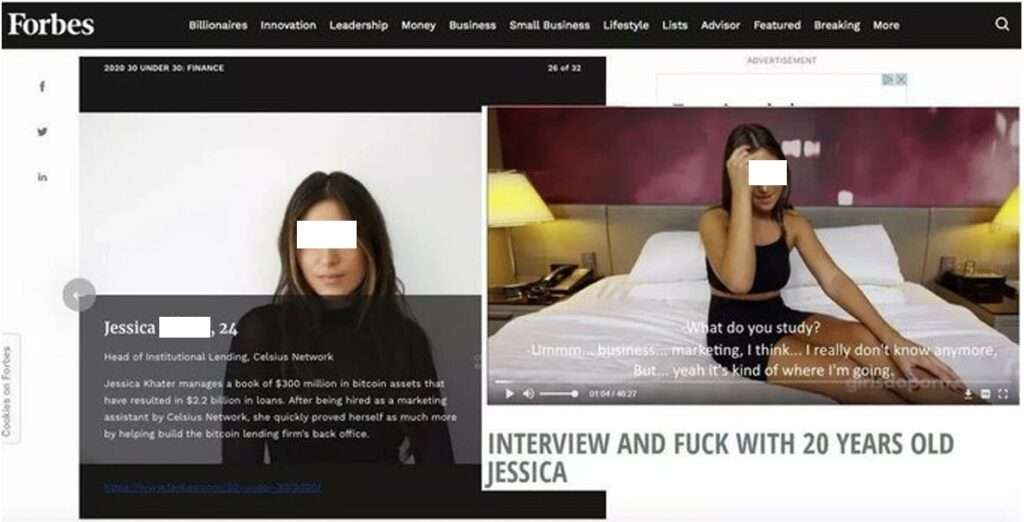
On June 13, 2022, Defendant Lyndon Perry published a post (the "Tweet") on the social media platform Twitter (currently known as X). The Tweet included a composite of two images: a still frame from the Video superimposed onto a screenshot of an online article from Forbes. The still frame from the Video depicts a fully clothed woman—who is identified as "Jessica" in the Video's title—sitting alone on a bed. The still frame includes text of an apparent conversation between the woman and an off-screen interviewer in which the woman states that she is studying business and marketing.
The screenshot from the Forbes article shows a profile of an individual, who is identified as the head of institutional lending at Celsius Network, in the publication's 30 Under 30 list for 2020. The Tweet juxtaposes these two images, suggesting that they are the same woman.
The Tweet was Perry's second post in a larger thread. The first post in the thread shows an advertisement for Celsius Network next to a screenshot of a Reuter's article entitled, "Crypto Firm Celsius Pauses All Transfers, Withdrawals, as Markets Tumble." Defendant then replied to this post with the Tweet, which included the composite image and the message "Same company btw."
MCM Group (the assignee of the copyright in the videos) sued for copyright infringement, but the court rejected the claim:
2/9/1937: NLRB v. Jones & Laughlin Steel Corp. argued.

Help Reason push back with more of the fact-based reporting we do best. Your support means more reporters, more investigations, and more coverage.
Make a donation today! No thanks
Every dollar I give helps to fund more journalists, more videos, and more amazing stories that celebrate liberty.
Yes! I want to put my money where your mouth is! Not interested
So much of the media tries telling you what to think. Support journalism that helps you to think for yourself.
I’ll donate to Reason right now! No thanks
Push back against misleading media lies and bad ideas. Support Reason’s journalism today.
My donation today will help Reason push back! Not today
Back journalism committed to transparency, independence, and intellectual honesty.
Yes, I’ll donate to Reason today! No thanks
Support journalism that challenges central planning, big government overreach, and creeping socialism.
Yes, I’ll support Reason today! No thanks
Support journalism that exposes bad economics, failed policies, and threats to open markets.
Yes, I’ll donate to Reason today! No thanks
Back independent media that examines the real-world consequences of socialist policies.
Yes, I’ll donate to Reason today! No thanks
Support journalism that challenges government overreach with rational analysis and clear reasoning.
Yes, I’ll donate to Reason today! No thanks
Support journalism that challenges centralized power and defends individual liberty.
Yes, I’ll donate to Reason today! No thanks
Your support helps expose the real-world costs of socialist policy proposals—and highlight better alternatives.
Yes, I’ll donate to Reason today! No thanks
Donate today to fuel reporting that exposes the real costs of heavy-handed government.
Yes, I’ll donate to Reason today! No thanks