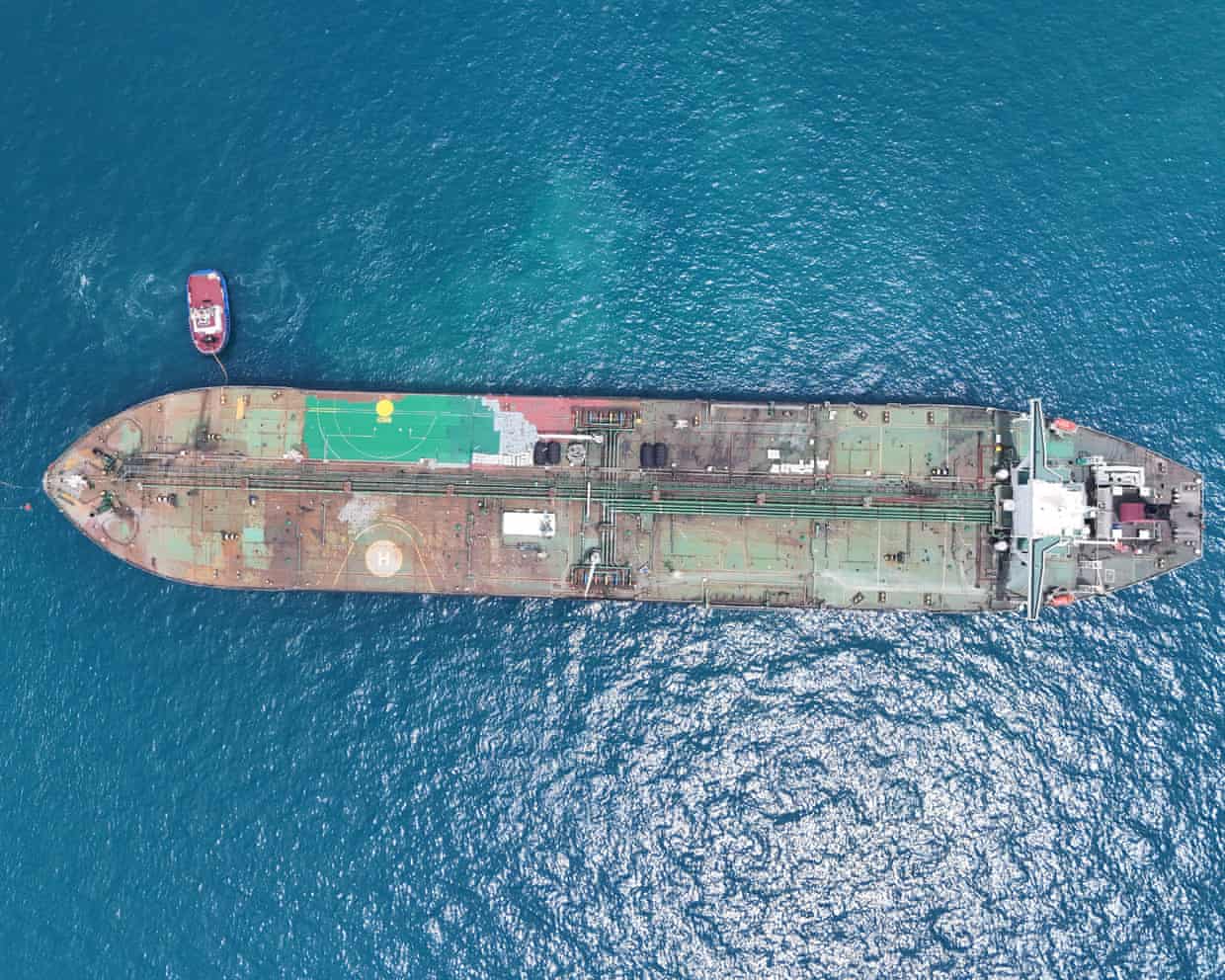
A drone view of oil tanker HELGA berthed at one of Iraq's southern offshore oil terminals near Basra as it prepares to load crude oil, becoming the second vessel to arrive since the closure of the Strait of Hormuz. Photograph: Mohammed Aty/Reuters
A drone view of oil tanker HELGA berthed at one of Iraq's southern offshore oil terminals near Basra as it prepares to load crude oil, becoming the second vessel to arrive since the closure of the Strait of Hormuz. Photograph: Mohammed Aty/Reuters
Oil hits highest level since US-Iran ceasefire began
The oil price has hit its highest level since the US and Iran agreed a ceasefire more than two weeks ago.
Brent crude traded as high as $107.48 a barrel this morning, its highest level since 7 April, the day when the US and Iran agreed to a conditional ceasefire.
The Brent crude oil price over the last three months Photograph: LSEG
That deal included a temporary reopening of the strait of Hormuz, after Donald Trump had threatened Iran with widespread destruction.
But with the strait still largely blockaged, and oil production in the region having more than halved since the war began (see earlier post), anxiety over the conflict is rising again today.
Brent crude had been trading around $72 a barrel before the war began, and hit $119.50 in early March (corrected).
Oil is up today despite Trump announcing last night that a ceasefire between Israel and Lebanon would be extended by three weeks.
But,when asked how long he was willing to wait for a long-term peace deal with Iran, Trump replied: “Don’t rush me”.
The risks to the oil price “remain tilted to the upside”, Fawad Razaqzada, market analyst at Forex.com, explains, as the US-Iran stalemate drags on.
Razaqzada adds:
“Oil has been on a firm upward trajectory this week, clearly driven by the collapse of planned talks between the US and Iran.
Tehran has refused to engage while the naval blockade remains in place, fuelling concerns over tightening supply and pushing prices well above $100 per barrel again.
There was a brief pause when Trump opted to extend the ceasefire, but the effect proved short-lived. With no clear timeline for negotiations and both sides entrenched, markets remain in limbo — and prices continue to grind higher.”
And finally…the London stock market has closed in the red tonight, just hours after Bank of England deputy governor Sarah Breeden’s warning of a possible correction.
The FTSE 100 share index has closed down 78 points, or 0.75%, at 10,379 points tonight.
Packaging firm Mondi (-11%) was the top faller, after warning that the Iran war was pushing up its costs.
Here’s our news story about the US Department of Justice dropping its criminal investigation against Federal Reserve chair JeromePowell, clearing the path for DonaldTrump’s new nominee for chair to be confirmed.
US consumer confidence has dropped this month, as fears grow that the Iran war is pushing up costs.
The University of Michigan’s consumer sentiment index has dropped this month, down 3.5 points to 49.8 points.
The measures of current economic conditions and of consumer expectations both declined during April.
Surveys of Consumers director Joanne Hsu said levels of consumer morale were now comparable to the trough seen in June 2022, adding:
Decreases in sentiment were seen across political party, income, age, and education.
Expected business conditions declined for both short and long time horizons, nearly matching year-ago readings when the reciprocal tariff regime was implemented. After the two-week cease-fire was announced and gas prices softened a touch, sentiment recovered a modest portion of its early-month losses.
The Iran conflict appears to influence consumer views primarily through shocks to gasoline and potentially other prices. In contrast, military and diplomatic developments that do not lift supply constraints or lower energy prices are unlikely to buoy consumers.
‘The damage is done’: global oil crisis has changed fossil fuel industry for ever, IEA chief says
Fiona Harvey
The oil crisis triggered by the Iran war has changed the fossil fuel industry for ever, turning countries away from fossil fuels to secure energy supplies, the world’s leading energy economist has said.
Fatih Birol, the executive director of the International Energy Agency (IEA), also said that, despite pressure, the UK should forgo much of its potential North Sea expansion.
Speaking exclusively to the Guardian, Birol said a key effect of the US-Israel war on Iran was that countries would lose trust in fossil fuels and demand for them would reduce.
“Their perception of risk and reliability will change. Governments will review their energy strategies. There will be a significant boost to renewables and nuclear power and a further shift towards a more electrified future,” he said. “And this will cut into the main markets for oil.”
Justice Dept to close investigation into Powell over Federal Reserve renovations
The US justice department is closing the criminal probe into Federal Reserve Chair Jerome Powell over cost overruns in renovations at the Fed.
The move, announced by US Attorney for DC Jeanine Pirro, appears to clear the way for Kevin Warsh, President Donald Trump’s pick to succeed Powell, to get confirmed for the role.
The investigation, announced in January, was examining whether Powell lied to Congress about the scope of a project to renovate the Fed’s buildings.
RAC: Pump prices falling but slower than anticipated.
There’s an old saying that the price of motor fuel goes up like a rocket, and down like a feather.
And it appears to be coming true again.
New data from the RAC shows that the average price of petrol has dipped by just 0.08p today to 157.22p a litre; that’s stil 18.4% higher than when the Iran war began.
Diesel is down 0.2p at 189.59p a litre, 33% higher than at the end of February.
RAC head of policy Simon Williams says retail prices are lagging falls in wholesale fuel prices:
“Pump prices aren’t falling at the rate that our analysis of wholesale data indicates they should, with petrol only having dropped a penny a litre since 15 April and diesel by 2p. Interestingly, we note that prices in Northern Ireland have reduced more quickly as unleaded has already come down by 2p and diesel by more than 4p in the last week.
“The fact the price of oil went back above $100 on Wednesday having been below that mark for 10 days is no doubt cause for concern for retailers. Despite this the cost of both fuels on the wholesale market is still lower than it has been, particularly so for diesel - so drivers really ought to see some cheaper prices at the forecourts in the coming days.”
Oil has now slipped back, following reports that Iranian foreign minister Abbas Araghchi is expected to travel to Pakistan for talks with the US this weekend.
Araghchi is expected to arrive in Islamabad tonight with a small delegation, according to government sources.
Following important discussions with the Pakistani mediation team, a second round of Islamabad peace talks between the United States and Iran is expected, government sources say.
A U.S. logistics and security team understood to already be present in Islamabad to facilitate the negotiation process.
Procter & Gamble has become the latest company to warn that the Iran war is pushing up its costs.
In its latest financial results, P&G flagged that now expects higher commodity costs to cost it around $150m after tax this financial year, on top of $400, of higher costs from tariffs.
Despite that, P&G is sticking with its previous financial guidance, after reporting sales growth of 7% in the last quarter.
Shailesh Jejurikar, president and chief executive officer of P&G, says:
“We’re increasing investments to accelerate momentum with consumers despite the challenging geopolitical and economic environment, while still maintaining our guidance ranges for the fiscal year.
We continue to believe the best path to sustainable, balanced growth is by strengthening execution of our integrated growth strategy. We are confident in the progress we’re making and excited about the longer-term opportunity to leverage P&G’s strengths and unique capabilities to create the CPG [consumer packaged goods] company of the future.”
Oil hits highest level since US-Iran ceasefire began
The oil price has hit its highest level since the US and Iran agreed a ceasefire more than two weeks ago.
Brent crude traded as high as $107.48 a barrel this morning, its highest level since 7 April, the day when the US and Iran agreed to a conditional ceasefire.