
Music is very much at the heart of what it is that makes us human. While there is debate over precisely why we first started making music – with leading theories arguing that it arose for purposes of hunting, communication, spiritual practice, and forging community bonds – what’s not debated is that music-making is something we pour ourselves deeply into, forging intimate relationships with our instruments.
The Met’s compelling new exhibition Musical Bodies looks at 4,000 years of musical history, teasing out the complex web of interrelationships between the sounds made through human bodies and the many instruments we have used to alter and augment those sounds. From singing, whistling and bodily percussion to a vast array of constructed objects, the show is a rich exploration of how our musical identities contribute to the notion of what it is to be human.
According to the exhibition curator, Bradley Strauchen-Scherer, it all began when the Met was renovating its galleries, meaning that Strauchen-Scherer had to physically transport some 600 of the institution’s musical instruments by hand. “Of course, as a curator you know your collection well,” said Strauchen-Scherer, “but actually having each and every one of those instruments in my hands, looking at them in an up-close way, I started to think about the common threads connecting all this.”
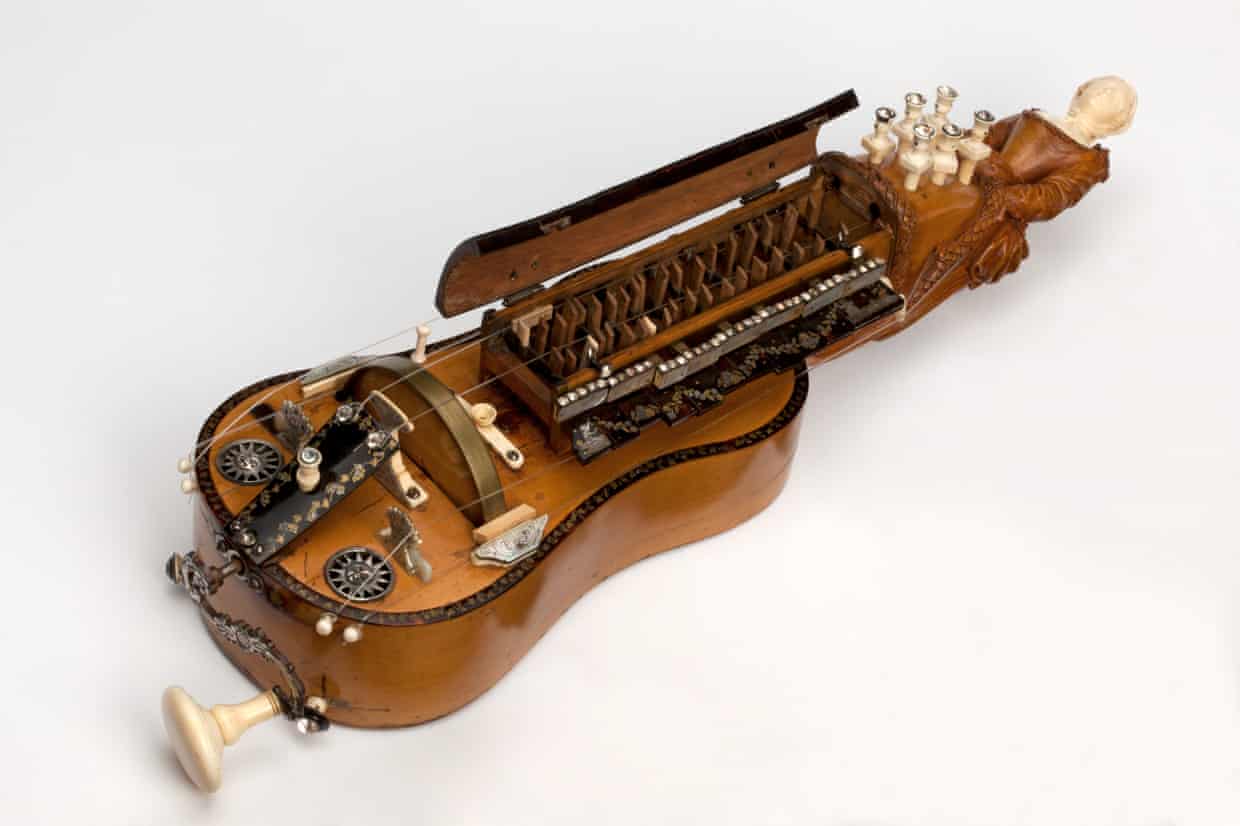
Those threads span thousands of years of human history and six of the world’s continents, moving from African drums to ancient Egyptian clappers, Prince’s androgynous guitars, Renaissance violins from Germany, a Tibetan kangling, and cutting-edge MiMu Midi gloves that translate movement into sound.
Running through Musical Bodies is an implicit thesis that the musical instruments humans have been fashioning over the centuries are receptacles for our yearning; sites for our identity and imagination to play out over. In their construction and design, they absorb our creative spirit, letting our humanity spill out into them and take shape in their form, decoration and distinctive sounds.
For instance, take Prince’s “symbol guitar,” which he commissioned in 1993 and was a staple of his stage performances. Looking like a mashup of a trumpet and the Venus and Mars symbols associated with the female and male genders, the icon was said to have emerged from Prince’s record label disputes – changing his name to that symbol was effectively a clever way to wiggle out of restrictive record label deals.
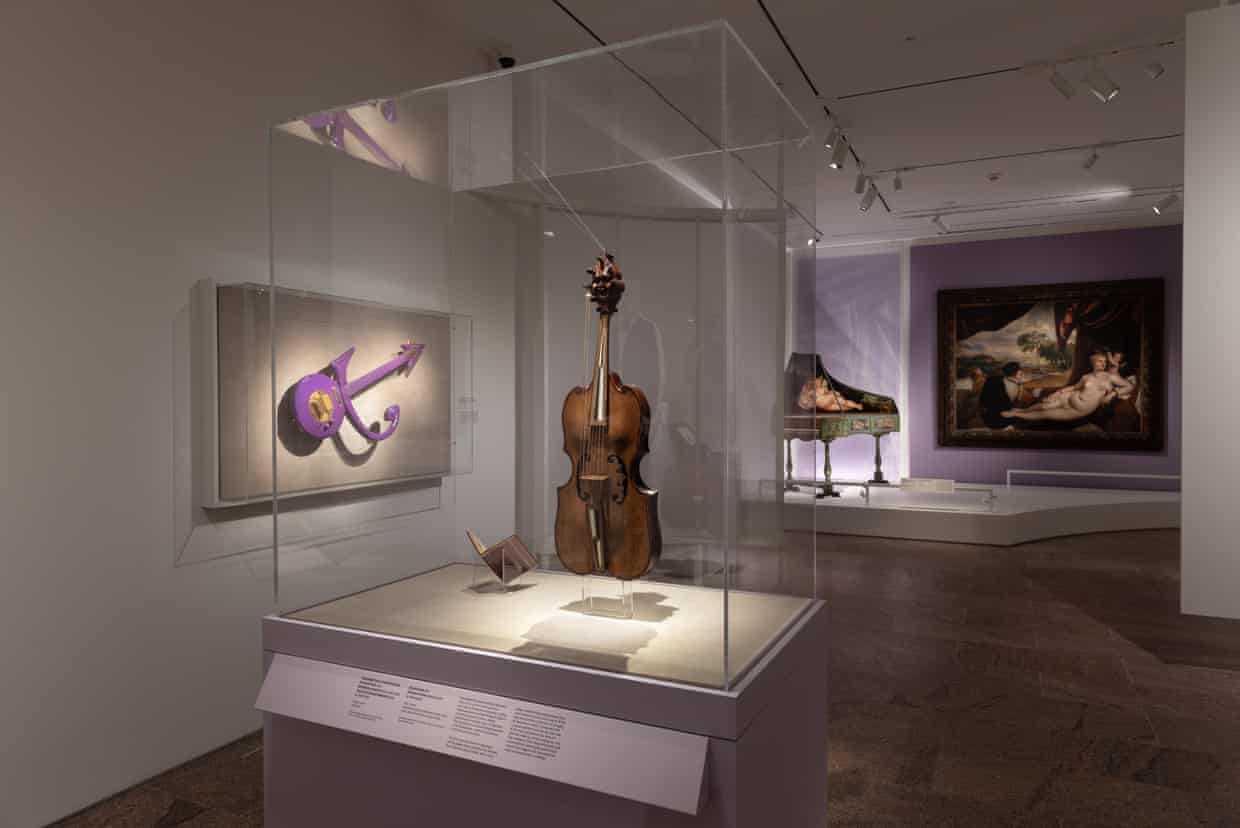
The truth, however, was far more complicated. Strauchen-Scherer said the symbol and its attendant guitar was the result of a deeply personal process of personal exploration for Prince, emerging out of his seemingly ceaseless creative energies, fusing his gender evolution with his creative musical pursuits. “Even before the record label narrative, Prince was working with his producers to express the totality of male and female with his shows,” Strauchen-Scherer said. “There’s that wonderful lyric from I Would Die 4 U – ‘I’m not a woman / I’m not a man / I am something that you’ll never understand’ – that just sums up everything there.”
When you’re talking about personal expression, it doesn’t get more basic than our voices, which Strauchen-Scherer likened to the musical instrument par excellence: “The human voice is the first sound that we make in the world, and it’s held up in many cultures as the thing that all instruments aspire to.” She also noted that it is common practice for those learning to play an instrument to concurrently learn to sing, as the grounding in the human voice makes one’s playing so much the richer.

Among the voices represented in Musical Bodies is the hip-hop collective the Beatbox House, whose extraordinary ability to mimic intricate drum sets with just their mouths defies belief. Effectively, in trying to emulate drum kits that were frequently beyond the financial reach of the early hip-hop artists who pioneered the form, beatboxers invented new possibilities for our voices. “It pushes the boundaries as it makes people think again about the human voice,” said Strauchen-Scherer.
Another fantastic voice is that is that of Molly Lewis, the international whistling champion whose musical talents reached a global audience in 2023 as a part of the film Barbie’s soundtrack. Although whistling like Lewis’s is an art form unto itself, Strauchen-Scherer said humans first whistled for eminently practical reasons. “People were originally whistling to communicate with each other,” she said. “It’s a sound that you can hear when you’re spread out.
Lewis’s vocal talents added a very emotionally rich and whimsical backdrop to the poignant scene in which the Barbie film spotlights Ruth Handler (portrayed by Rhea Perlman), the creator of the first Barbie doll. Lewis’s gracefully looping vocal sounds make a fascinating counterpoint to beatboxing’s staccato movement, showcasing just how diverse the human voice can be.
One of the larger subsections in Musical Bodies documents how musical instruments have long been a part of courtship – and how they have even been stand-ins for the sexual act itself. In the right hands, these devices take on heavy symbolic weight, and even just holding one – much less playing it – can be a norm-shattering gesture.
Take, for instance, the Japanese woodblock print titled Bun’ya no Asayasu, made by the prolific 19th-century artist Utagawa Kunisada. It features a woman suggestively holding a shakuhachi – a large Japanese flute – up to her mouth, with a gleeful expression on her face. According to Strauchen-Scherer, a woman handling a flute like that would have been considered quite risque at the time.

“In Japanese culture, as in western culture until fairly recently,” she explained, “it was considered taboo and very sexually suggestive for women to play instruments like flutes and recorders, anything that goes in your mouth. I mean, the slang goes right along with it – think about the expression, ‘playing the skin flute’.”
Then there’s the well-known painting The Musician by the 17th-century Dutch artist Bartholomeus van der Helst, one of the most celebrated portraitists of the golden age of Dutch painting. Featuring a woman tuning an instrument in order to play it, the subtext of the painting is quite clear, Strauchen-Scherer said. “She’s tuning a lute, she’s practically falling out of her dress,” she said. “Tuning a musical instrument is a well-known allegory for foreplay.”
Ultimately, Strauchen-Scherer hopes that audiences will come away from Musical Bodies with a new appreciation for music – which admittedly can become easily taken for granted when it’s plastered as wallpaper in virtually every store and cafe, and when we’re continuously piping it into our ears via streaming services. “I hope this will re-center music for people,” she said. “I want audiences to see music as central to human identity, what we do. Music is for all of us because we are instruments.”
-
Musical Bodies is now on display at the Metropolitan Museum of Art in New York until 27 September